Stereo extrinsics — recovering a rig's camera-to-camera transform¶
Run alongside this:
python examples/06_stereo_extrinsics_tumvi.py --stride 8(after the setup). Read this, then read the printed numbers.
On this page - §1: Run the example and interpret the results - §2: Understand why a shared board cancels the unknown motion - §3–5: Code your way through per-frame poses, alignment, and averaging - §6: Score against the reference and learn the rotation/translation scale trade-off
The capstone recovered one camera's intrinsics — the numbers that map a 3D ray to a pixel.
A stereo rig adds a second number that matters just as much: the extrinsic, the rigid
transform T_cam1_cam0 that places one camera relative to the other. Every depth-from-stereo
and visual-inertial pipeline needs it.
You recover that transform here from TUM-VI's real, hardware-synced fisheye footage and check it against the dataset authors' published value — landing rotation to 0.06° and baseline within ~0.2%. The whole method rests on one cancellation, which §2 shows you.
You'll learn
- The mental model: why two synced cameras watching the same board hand you their relative
pose for free, even though the board is moving and its pose is unknown.
- How to turn per-frame board poses into a single rig transform with
estimate_relative_pose.
- How to score the result against a published reference with relative_pose_error, and what
"rotation is scale-free, translation is not" means in practice.
Prerequisites
- Finish Chapter 2 and skim the
capstone — this chapter reuses its per-camera
calibration step and assumes you've seen AprilGrid detection.
- The [calib] install and the TUM-VI calib data:
Scope
Two different functions share the name estimate_relative_pose:
ds_msp.calib.estimate_relative_pose— averages per-frame board poses into a rig transform. This chapter's topic.ds_msp.mvg.estimate_relative_pose— recovers pose from raw feature matches instead (the essential matrix on bearing vectors). That's Chapter 8's topic.
This chapter anchors only to ds_msp.calib.
1. The minimal working example¶
Run the companion script. It detects the board in both cameras, calibrates each, composes the extrinsic, and compares to the reference — the whole pipeline in one command:
$ python examples/06_stereo_extrinsics_tumvi.py --stride 8
Detecting AprilGrid in 55 synced stereo pairs ...
  55 frames with >=6 tags in both cameras
Calibrating each camera ...
  cam0 fx,fy,cx,cy = [190.99 190.98 254.96 256.84]
  cam1 fx,fy,cx,cy = [190.39 190.36 252.64 254.98]

Stereo extrinsics  T_cam1_cam0  (from 55 frames)
  mine       baseline  101.27 mm   t = [-101.25   -1.93   -1.02]
  published  baseline  101.09 mm   t = [-101.06   -1.98   -1.18]

  rotation error      : 0.060 deg
  translation error   : 0.25 mm
  per-frame spread     : rot RMS 0.10 deg, t std [0.8 0.8 0.7] mm
That last block is the result. Starting from raw footage, the recovered T_cam1_cam0 matches
the published reference to 0.060° in rotation and 0.25 mm in translation — baseline
101.27 mm vs 101.09 mm, about 0.2% off.
The rest of the chapter walks through how those numbers appear, one step at a time.
Note
--stride 8 keeps every 8th synced pair (55 frames here), so the per-camera bundle adjustment
finishes in well under a minute.
A smaller stride uses more frames and shifts the numbers slightly — the values above are the
--stride 8 run. If you quote a number, quote the stride that produced it.
2. The mental model: the shared board cancels out¶
One insight carries the whole chapter: a shared board lets the rig transform fall out for free.
Both cameras are hardware-synced, so at each timestamp i they photograph the board in the
exact same position.
Calibrating each camera gives you, per frame, the board's pose in that camera's coordinate frame:
T_cam0_board[i]— where the board sits, seen from cam0.T_cam1_board[i]— the same physical board, seen from cam1.
The board's pose is unknown and different every frame (someone is waving it around). But the two cameras are bolted together, so the transform between them never changes.
The cancellation formula¶
Compose one board pose with the inverse of the other and the moving board cancels:
Read it right to left: take a point in cam0's frame, go back to the board, then forward into cam1. The board is the bridge.
Because both cameras saw the same board at frame i, that bridge is identical on both sides
and drops out, leaving the fixed rig transform.
graph LR
    C0["cam0 frame"] -->|"(T_cam0_board)⁻¹"| B["shared board<br/>(same for both,<br/>cancels)"]
    B -->|"T_cam1_board"| C1["cam1 frame"]
    C0 -.->|"T_cam1_cam0 (what we want)"| C1
Why you average across frames¶
Every frame gives one estimate of T_cam1_cam0. With 55 frames you get 55 estimates of the
same fixed quantity — so you average them.
The spread across frames tells you how much to trust the result; that averaging is the next step.
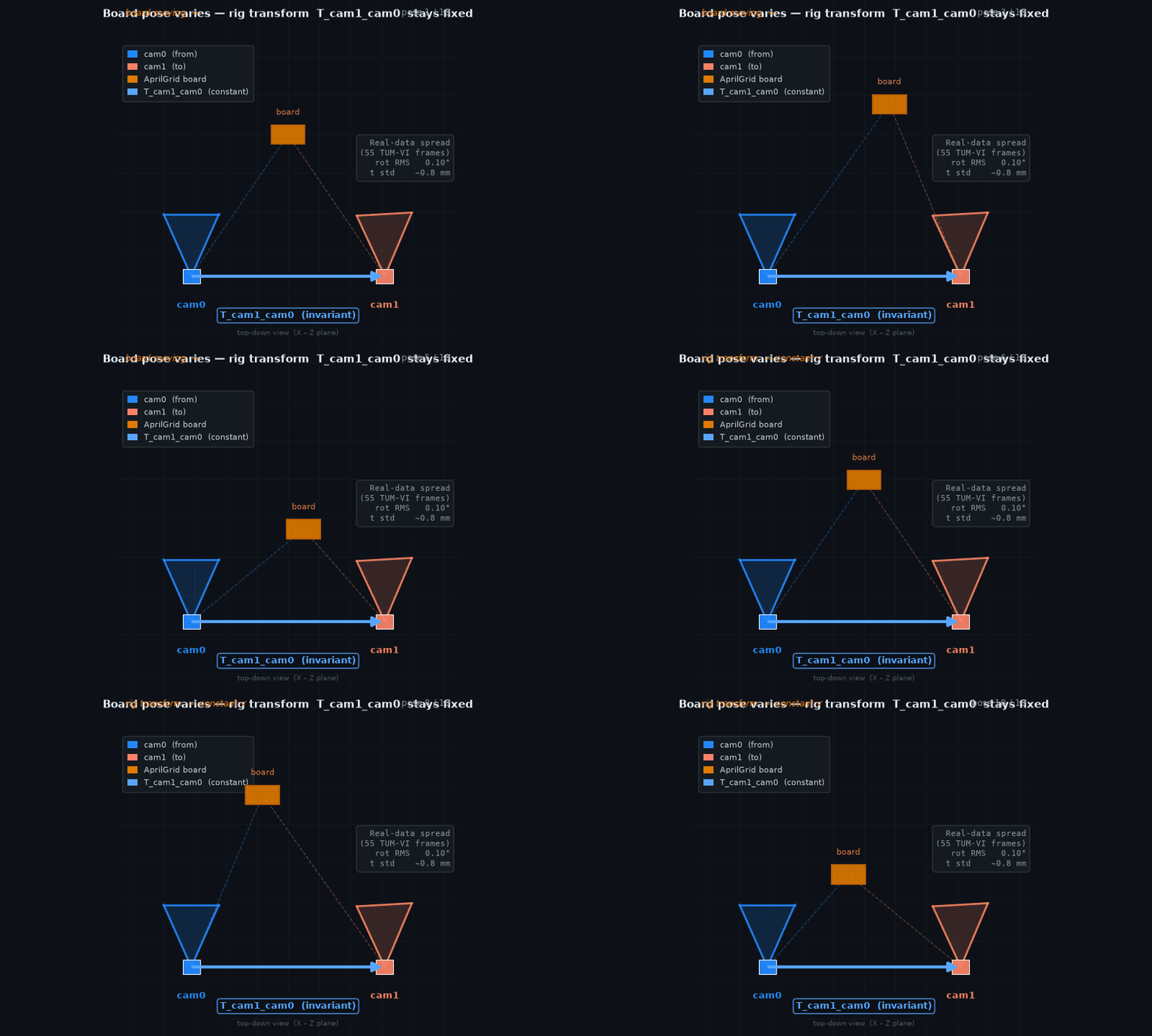 Cameras bolted in place (blue = cam0, orange = cam1); an AprilGrid board sweeps through ten
positions. Each frame recovers
Cameras bolted in place (blue = cam0, orange = cam1); an AprilGrid board sweeps through ten
positions. Each frame recovers T_cam1_cam0 via estimate_relative_pose — the rig arrow stays
pinned while the board moves, the §2 cancellation in action.
(Top-down X–Z view; real ds_msp geometry, lie factor = 1.000.)
3. Get the per-frame board poses¶
estimate_relative_pose needs the board pose, per frame, from each camera. Those come
straight out of the per-camera calibration: calibrate returns a "poses" list alongside the
intrinsics.
The excerpts below follow
examples/06_stereo_extrinsics_tumvi.py,
which wraps this step in calibrate_camera. They need the TUM-VI dataset from the
setup, so they don't run standalone:
The snippets below continue from this setup:
import os, glob
import numpy as np
from ds_msp.calib import (AprilGridTarget, calibrate, detect_aprilgrid,
                          estimate_relative_pose, relative_pose_error)
from ds_msp.io import load_kalibr_extrinsics
from ds_msp.models import KannalaBrandtModel

SEQ = "datasets/tumvi/dataset-calib-cam1_512_16/mav0"
CAMCHAIN = "datasets/tumvi/dataset-calib-cam1_512_16/dso/camchain.yaml"
target = AprilGridTarget(tag_rows=6, tag_cols=6, tag_size=0.088, tag_spacing=0.3)
def calibrate_camera(detections, target):
    """One camera -> (intrinsics, per-frame board poses)."""
    Xs, UVs, VIs = target.build_correspondences(detections, min_corners=8)
    seed = KannalaBrandtModel(fx=190, fy=190, cx=256, cy=256)   # rough fisheye guess
    out = calibrate(seed, Xs, UVs, VIs, max_nfev=120, loss="cauchy", f_scale=0.5)
    return out["model"], out["poses"]   # poses[i] = (rvec(3,), tvec(3,)) board->cam, metres
Each entry of poses is a (rvec, tvec) pair: a Rodrigues rotation vector and a translation
in metres, encoding T_camN_board for that frame. That (rvec, tvec) tuple is exactly the
Pose type estimate_relative_pose expects.
Notice that each tvec points from the board origin to the camera, expressed in the camera's
frame — not from the camera to the board. Get this direction backwards and the §2 cancellation
composes the wrong way.
Note
The translation unit is metres because the board's metric size is set by tag_size=0.088
(88 mm tags). Hold that thought.
It's why §6's translation is only as accurate as that 88 mm assumption, while the rotation needs no scale at all.
4. Frame alignment: same index, same timestamp¶
estimate_relative_pose(poses_from, poses_to) assumes poses_from[i] and poses_to[i] are
the same frame seen by the two cameras. Keep that alignment airtight. Mix in board poses
from different moments and the §2 cancellation breaks.
TUM-VI makes alignment easy: cam0 and cam1 store synced frames under the same filename (the
timestamp). This excerpt (from
main())
builds matched path lists, then keeps only frames where both cameras detected enough of the
board:
names = sorted(os.path.basename(p) for p in
               glob.glob(os.path.join(SEQ, "cam0", "data", "*.png")))[::8]   # stride 8
cam0_paths = [os.path.join(SEQ, "cam0", "data", n) for n in names]
cam1_paths = [os.path.join(SEQ, "cam1", "data", n) for n in names]

det0 = detect_aprilgrid(cam0_paths, family="t36h11", min_tags=0, refine=True)
det1 = detect_aprilgrid(cam1_paths, family="t36h11", min_tags=0, refine=True)
keep = [i for i in range(len(names)) if len(det0[i]) >= 6 and len(det1[i]) >= 6]
det0 = [det0[i] for i in keep]
det1 = [det1[i] for i in keep]
print(f"{len(keep)} frames with >=6 tags in both cameras")   # -> 55 frames with >=6 tags in both cameras
The keep filter is the load-bearing line: it drops any frame one camera saw poorly, so the
two pose lists stay index-aligned. After it, poses0[i] and poses1[i] are guaranteed to be
the same physical board pose.
5. Compose and average into one rig transform¶
Hand the two aligned pose lists to estimate_relative_pose. Pass cam0 first and cam1 second to
get T_cam1_cam0 (Kalibr's T_cn_cnm1 for cam1 — "this camera from the previous one"):
cam0, poses0 = calibrate_camera(det0, target)
cam1, poses1 = calibrate_camera(det1, target)

rig = estimate_relative_pose(poses0, poses1)   # poses_from=cam0, poses_to=cam1
print(rig["n"])                                # -> 55  (frames averaged)
print(np.round(rig["t"] * 1000, 2))            # -> [-101.25  -1.93  -1.02]  (mm)
print(f"{rig['rot_rms_deg']:.2f}")             # -> 0.10  per-frame rotation spread, deg
Under the hood it does exactly §2, then averages robustly across frames:
- Rotation — it averages the 55 rotation matrices element-wise, then projects the result
back onto a valid rotation with an
SVD (
R = U Vᵀ). Averaging matrices then re-orthonormalizing is the standard chordal mean on SO(3); a plain element-wise average isn't a rotation, the SVD fixes that. - Translation — it takes the component-wise median of the 55 translation vectors, which shrugs off the occasional bad-PnP frame far better than a mean.
The returned dict also reports the spread: rot_rms_deg (0.10°) and t_std_mm
([0.8 0.8 0.7] mm). These are consistency numbers — how much the per-frame estimates
disagree among themselves.
A small spread means the 55 frames tell the same story — your first signal the answer is trustworthy, before you ever look at the reference.
6. Score it against the published reference¶
The payoff: compare the recovered transform to the value TUM-VI's authors published. This
excerpt (from
main())
loads the extrinsic from the camchain and diffs the two transforms with relative_pose_error:
published = load_kalibr_extrinsics(CAMCHAIN, cam="cam1")   # 4x4 T_cn_cnm1 = T_cam1_cam0
err = relative_pose_error(rig["T"], published)
print(round(err["rot_deg"], 3))    # -> 0.060   rotation angle between the two, deg
print(round(err["trans_mm"], 2))   # -> 0.25    translation difference, mm

print(round(np.linalg.norm(rig["t"]) * 1000, 2))            # -> 101.27  my baseline, mm
print(round(np.linalg.norm(published[:3, 3]) * 1000, 2))    # -> 101.09  published baseline, mm
relative_pose_error returns two numbers: rot_deg, the geodesic angle between the two
rotations (how far you'd have to rotate one to match the other), and trans_mm, the Euclidean
distance between the two translation vectors.
0.060° and 0.25 mm — recovered from raw footage, matching a published reference to a sixteenth of a degree.
Rotation vs. translation: the scale trade-off¶
The critical scale subtlety — the one thing readers get wrong — is this:
| Quantity | Source | Why it matters |
|---|---|---|
| Rotation (0.060°) | Comes from directions only; never needs metric size. | Unconditional. It would hold even if you'd guessed the tag size wrong by 10%. |
| Translation (0.25 mm / ~0.2%) | Carries the scale you assumed (tag_size=0.088). Get that wrong by 1% and every distance scales by 1%. |
Proof that 88 mm is the right tag size and a proxy for overall measurement fidelity. |
This is why the example phrases the result as "rotation to a sixteenth of a degree, baseline to ~0.2%": the two numbers are trustworthy for different reasons and speak to different kinds of error.
Recap¶
You recovered a stereo rig's extrinsic transform from real footage and proved it against a published reference. Here is what you achieved:
| Quantity | Recovered (--stride 8) |
Published | Agreement |
|---|---|---|---|
| Rotation | — | — | 0.060° error |
| Baseline | 101.27 mm | 101.09 mm | 0.25 mm (~0.2%) |
| Per-frame spread | rot RMS 0.10°, t std ~0.8 mm | — | self-consistency |
The mechanism, in one line: synced cameras share the board, so per frame
T_cam1_cam0 = T_cam1_board ∘ (T_cam0_board)⁻¹ — the moving board cancels, and you robustly
average the per-frame estimates (chordal mean for rotation, median for translation).
Rotation is scale-free; translation inherits the assumed 88 mm tag size.
Try it yourself¶
Deepen your understanding by modifying the code. Each of the following exercises isolates one part of the method:
- Swap the argument order. Call
estimate_relative_pose(poses1, poses0)instead. Predict the baseline sign before you run: you've asked forT_cam0_cam1, the inverse rig transform. Doesrot_degagainstpublishedchange? (It should jump — you're now comparing inverse to forward.) - Break the scale on purpose. Re-run with
tag_size=0.066in theAprilGridTarget. Predict what happens torot_degvstrans_mmbefore you look.
Rotation stays unchanged; the baseline scales by 66/88, so the translation error blows up while rotation stays put — the §6 lesson, measured.
If you followed the snippets rather than the full script, redefine target with the new
tag_size. Then re-call calibrate_camera on both cameras before re-running §5.
3. Use more frames. Drop --stride to 4. Does the per-frame spread (rot_rms_deg) shrink,
and does the agreement with the reference improve? More frames usually tighten the average.
Next steps¶
- Use the extrinsic for depth. With
T_cam1_cam0in hand, the two cameras define an epipolar geometry — the constraint fixing where a point in one image can land in the other, and the basis for stereo depth. See Part II → Sphere-sweep stereo depth, which gets dense depth straight from raw fisheye. - Recover pose without a board. This chapter leaned on a known calibration target. The
ds_msp.mvgtwo-view geometry recovers relative pose from feature matches alone — the essential matrix on bearing vectors. See Chapter 8 — Two-view geometry on rays. - Reference: the two functions used here live in
ds_msp/calib/stereo.py; the camchain I/O inds_msp/io/kalibr.py.