Learn: fisheye & omnidirectional camera geometry, from first principles
A guided, runnable path through wide-FOV camera models — the geometry behind SLAM, AR, and robot perception.
Every chapter pairs a short explainer with a script that runs on real public data and prints a number you can verify.
The house rule
In 3D vision you don't hope your math is right — you measure that it is. A good unprojection inverts projection to ~1e-14 px, not "looks about right."
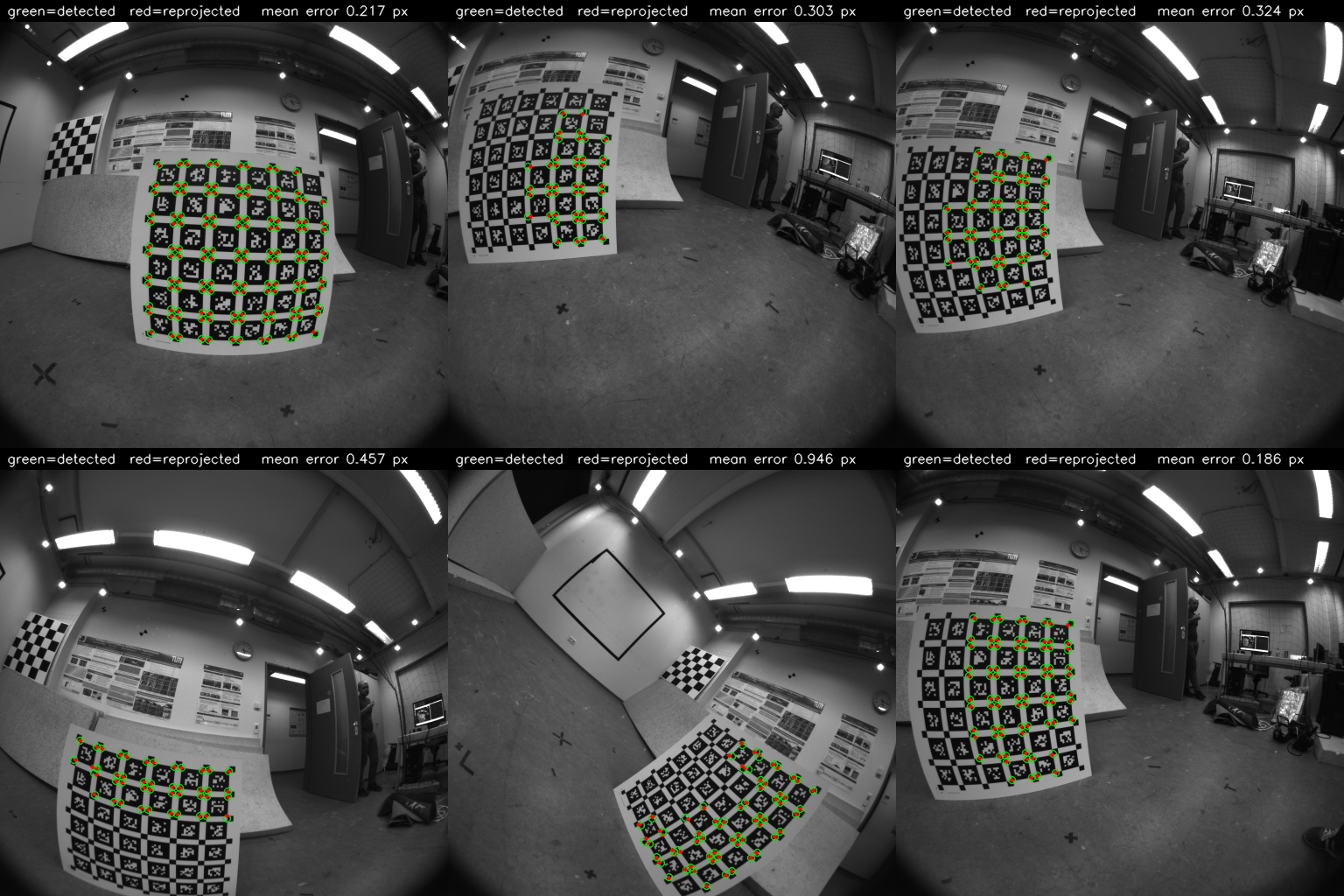
Where this leads — the capstone: calibrate a real fisheye from scratch until the model (red) predicts every detected corner (green) to a tenth of a pixel, matching the published reference.
This is the teaching layer. The library it teaches (ds_msp/) stays deliberately clean
and untouched by tutorial clutter:
- Read the docs to learn.
- Read the code to see how it's done in production.
Looking for the "why" behind a proof or a derivation, not a hands-on walkthrough? That lives in Explanation — kept separate so this track stays runnable end to end.
Who this is for
Aspiring 3D-vision researchers, applied-perception engineers, and developers who know some Python + linear algebra and want to actually understand (not just call) camera models. No prior fisheye knowledge assumed.
Setup (once)
# 1. Environment (uv recommended; venv/conda fine too)
uv venv --python 3.12 && source .venv/bin/activate
uv pip install -e .            # core library (Chapters 1–2)
uv pip install -e ".[calib]"   # + AprilGrid detector, for the calibration capstone

# 2. Data — small, free, ~3 GB for the fisheye track
bash scripts/download_datasets.sh tumvi
datasets/README.md for what each dataset contains.
The path
The track has two arcs:
- Part I — Calibration takes one camera from "what is a fisheye" to a published-grade calibration you reproduce yourself, then a set of companion chapters that go deeper on specific pieces of that pipeline.
- Part II — Geometry & 3D takes that calibrated camera out into the world: two-view pose, manifold optimization, and stereo depth — the geometry behind SLAM and SfM.
Part II's library is shipped and tested (ds_msp/mvg/, ds_msp/core/,
ds_msp/stereo/). Its chapters and runnable examples are landing now — see the
ROADMAP.
graph LR
subgraph PI["Part I · Calibration"]
A1["1 · Camera<br/>models"] --> A2["2 · Double<br/>Sphere"]
A2 --> A3["3 · Validity<br/>& the >180° cone"]
A2 --> CAP["🏆 Capstone:<br/>calibrate a real camera"]
A3 -.-> A4["4 · Analytic<br/>Jacobians"]
A4 -.-> A5["5 · LM<br/>calibration"]
A5 -.-> CAP
CAP --> DD["Companions:<br/>AprilGrid · robust loss ·<br/>stereo extrinsics · charts"]
end
subgraph PII["Part II · Geometry & 3D"]
B8["8 · Two-view<br/>geometry on rays"] --> B9["9 · Optimizing<br/>on the manifold"]
B9 --> B10["10 · Scalable<br/>bundle adjustment"]
B8 --> B11["11 · Sphere-sweep<br/>stereo depth"]
B11 --> B12["12 · Spherical<br/>rectification"]
end
CAP ==> B8- Solid arrows = runnable today: Ch.1 → Ch.2 → capstone → companions.
- Dotted arrows = theory chapters landing incrementally.
- Part II Ch.8 is runnable today; Ch.9–12 land incrementally on top of the shipped, tested library.
Part I — Calibration
| # | Chapter | You'll be able to… | Code anchor |
|---|---|---|---|
| 1 | Fisheye & camera models | load a real calibration, prove project/unproject are inverses, rectify a fisheye frame | examples/01_realdata_fisheye_tumvi.py |
| 2 | The Double Sphere model | derive DS projection, read it in code, and reproduce a published calibration with it | examples/02_double_sphere_tumvi.py |
| 3 | Projection validity & the >180° cone | explain why z>0 is the classic bug, and measure the >180° valid cone (227° here) |
examples/07_fov_and_validity.py |
| 4 | Analytic Jacobians vs autodiff (coming soon) | derive a Jacobian and gradient-check it | ds_msp/model.py |
| 5 | Calibration by Levenberg–Marquardt (deep-dive coming soon — the recipe itself already runs) | calibrate from corner detections | capstone, how-to → ds_msp/calib/bundle.py |
| 6 | One model to another: conversion | turn a DS calib into KB/EUCM without re-shooting | ds_msp/adapt/ |
| 7 | Reproducing a published calibration (TUM-VI done via the capstone; EuRoC coming soon) | match TUM-VI / EuRoC reference numbers with your own code | capstone → ds_msp/io/kalibr.py |
🏆 The capstone (runnable now)
Calibrate a real fisheye camera and match the published numbers is the artifact every chapter builds toward.
Detect AprilGrid corners in TUM-VI's raw footage, bundle-adjust the intrinsics from scratch, and land on the calibration the dataset authors published — to ~0.02% focal (0.080 px median reprojection).
You can run it after Chapter 2. Code: examples/03_calibrate_tumvi_aprilgrid.py.
Capstone companions — go deeper on one piece of the pipeline
Each of these takes a specific step inside the capstone and puts it under a microscope — same TUM-VI data, a runnable script, and a number you verify.
Read them after the capstone, in any order. They don't depend on each other.
| Chapter | You'll be able to… | Code anchor |
|---|---|---|
| Detecting every AprilGrid tag, even at the fisheye periphery | explain why a fully-visible board drops to 4/36 tags off-centre, and apply the multi-scale + board-guided recovery fix that takes recall 36%→94% and tightens the focal fit 0.7%→~0.02% | examples/03_calibrate_tumvi_aprilgrid.py |
| Robust losses vs hard rejection — and why naive RMS lies | apply a Cauchy loss that down-weights bad corners without discarding them, derive the IRLS weighting, and score a robust fit by median / inlier RMS instead of RMS | examples/04_robust_vs_rejection.py |
| Stereo extrinsics: recovering a rig's camera-to-camera transform | recover a rig's camera-to-camera transform from a shared board, average per-frame poses (chordal mean + median), and score it against a published reference (0.062° rotation, 0.25 mm baseline, ~0.2%) | examples/06_stereo_extrinsics_tumvi.py |
| Sphere, cylinder, pinhole: one camera, three images, and the pixel math that links them | derive the exact pixel↔pixel maps between three charts of the same camera (verified to 1e-13 px round-trip), and find where the cylinder silently drops the polar cone | examples/08_reproject_sphere_cylinder.py |
Chapters land incrementally — see ../ROADMAP.md for the build order.
Part II — Geometry & 3D (library shipped & tested; chapters + examples landing)
A fisheye measures rays, so this whole arc is built on project / unproject:
- Epipolar lines become curves.
- Disparity becomes angular.
- The essential matrix still holds — on unit bearing vectors.
| # | Chapter | You'll be able to… | Code anchor (shipped) |
|---|---|---|---|
| 8 | Two-view geometry on rays | recover relative pose from an image pair — essential matrix on bearings, ray triangulation, on-sphere RANSAC — on a real TUM-VI fisheye pair | ds_msp/mvg/ (two_view.py, ransac.py) |
| 9 | Optimizing on the manifold (chapter pending) | see why flat pose parameterization is a correctness bug, and how an in-house SO(3)/SE(3) LM solver fixes it | ds_msp/core/ (lie.py, optimize.py) |
| 10 | Scalable bundle adjustment (chapter pending) | minimize angular reprojection error with a Schur-complement sparse solve | ds_msp/mvg/bundle.py, ds_msp/calib/bundle.py |
| 11 | Sphere-sweep stereo depth (chapter pending) | get dense depth straight on raw fisheye — no rectification, no pinhole detour | ds_msp/stereo/sphere_sweep.py |
| 12 | Spherical epipolar rectification (chapter pending) | the pedagogically-clean depth path; matches sphere-sweep to <1% | ds_msp/stereo/rectify.py |
Chapter 8's formal companion — the epipolar-constraint proof, the four-fold decomposition, and the numerical-stability notes — lives in Explanation: Two-view geometry on bearing vectors.
Looking for the "why", not the "how"?
Some questions in this space aren't a hands-on skill — they're a conceptual puzzle worth settling once, in depth:
- "Are two calibrations of the same lens really the same camera?"
- "Which model should I pick?"
Those live in Explanation, so this tutorial track stays focused on runnable, hands-on chapters.
How to use it
Read the chapter, run its script, then change one thing and predict what happens before you re-run. Try:
- A different
balance. - A wider pixel grid.
cam1instead ofcam0.
The fastest way to learn geometry is to break it on purpose and watch the number move.