Chapter 8 — Two-view geometry on rays¶
For: readers who can already turn a fisheye pixel into a bearing ray (Chapters 1–3) and now want the relative pose
(R, t)between two views of the same scene — without ever touching a pinhole.
Two images of one rigid scene fix the camera's motion between them, up to the scale of the translation.
This chapter recovers that motion from feature correspondences expressed as unit bearing rays — the native currency of a wide-FOV camera.
You'll go from 8 ray pairs to a pose in five lines.
You'll see why the math is identical for any central camera, make it robust to wrong matches, and finish on a real TUM-VI fisheye pair.
You'll learn - Recover
(R, t)from ray correspondences withrecover_pose— and prove it on a synthetic Double Sphere scene to < 1e-3°. - Why the eight-point algorithm works on bearings, not just pixels. - The cheirality step, and why "in front" is positive depth along the bearing ray (λ > 0), notz > 0(the Chapter 3 callback). - Make pose robust to outliers withransac_relative_pose: < 0.5° under 30% bad matches.Prerequisites - Chapter 1 —
project/unprojectare inverses; a ray isunproject(pixel). - Chapter 3 — whyz > 0is the wrong validity/cheirality test for a >180° lens. - You've run the dataset fetcher (for §6). Setup: the project README.Theory lives elsewhere. This is a tutorial: it runs code and reports numbers. For the epipolar-constraint derivation, the four-fold decomposition proof, and numerical-stability notes, read the explanation page Two-view geometry. The chapter links to it; it does not restate it.
On this page¶
- The smallest thing that works
- Why rays, not pixels
- The eight-point estimator
- Cheirality and decomposition
- Robust matching with RANSAC
- Real data: TUM-VI
- Exercises
1. The smallest thing that works: rays in, pose out¶
Give recover_pose eight or more ray correspondences. It returns the relative rotation, the
unit translation direction, and the triangulated 3D points.
The complete call¶
Here is the complete API call on a synthetic scene, before any theory:
"""Chapter 8 -- the smallest thing that works: rays in, pose out.

`recover_pose` takes >=8 unit bearing-ray correspondences and returns the relative
rotation, the unit translation direction, and the triangulated 3D points. Rays here
are built directly from ground-truth 3D points (no pixels, no lens model), so with no
noise to absorb the recovered pose is exact to float64 round-off.
"""

import numpy as np

from ds_msp.mvg import recover_pose


def rodrigues(axis, angle):
    a = np.asarray(axis, float)
    a = a / np.linalg.norm(a)
    K = np.array([[0, -a[2], a[1]], [a[2], 0, -a[0]], [-a[1], a[0], 0]])
    return np.eye(3) + np.sin(angle) * K + (1 - np.cos(angle)) * (K @ K)


def rot_err_deg(A, B):
    return np.degrees(np.arccos(np.clip((np.trace(A.T @ B) - 1) / 2, -1, 1)))


def dir_err_deg(a, b):
    a, b = a / np.linalg.norm(a), b / np.linalg.norm(b)
    return np.degrees(np.arccos(np.clip(abs(a @ b), -1, 1)))


def main() -> None:
    # A ground-truth relative pose (R, t) maps a point from camera 1 to camera 2: X2 = R @ X1 + t.
    rng = np.random.default_rng(1)
    R_true = rodrigues(rng.standard_normal(3), 0.6)                     # 0.6 rad rotation
    t_true = rng.standard_normal(3)
    t_true /= np.linalg.norm(t_true)                                   # unit translation

    # 40 random 3D points in front of camera 1, seen by both cameras.
    X1 = np.column_stack([rng.uniform(-2, 2, 40), rng.uniform(-2, 2, 40), rng.uniform(2, 8, 40)])
    X2 = (R_true @ X1.T).T + t_true

    # Turn each point into a unit BEARING RAY in its camera (no pixels, no model -- just directions).
    f1 = X1 / np.linalg.norm(X1, axis=1, keepdims=True)                # (40, 3) unit rays, camera 1
    f2 = X2 / np.linalg.norm(X2, axis=1, keepdims=True)                # (40, 3) unit rays, camera 2

    R, t, X = recover_pose(f1, f2)                                     # R: (3,3), t: (3,), X: (40,3)

    print(f"rotation error       : {rot_err_deg(R_true, R):.2e} deg")
    print(f"translation-dir error: {dir_err_deg(t_true, t):.2e} deg")


if __name__ == "__main__":
    main()
What just happened¶
You build the rays straight from the 3D points, so no pixel and no lens model ever touch
them. With no noise to absorb, recover_pose inverts the geometry exactly.
Both errors come back at the float64 round-off floor — typically 0.00e+00, though the exact
last few digits (and whether it prints as exactly zero or something like 1e-6) depend on your
platform's BLAS/LAPACK backend. In §4 the same demo routes points through a real camera's
project/unproject, and the errors there are tiny but nonzero for a real, non-platform reason:
the project/unproject round-trip itself isn't a perfect bijection.
That is the entire workflow. The rest of this chapter walks each piece, makes it survive real
data, and replaces 0.00e+00 with the honest numbers a real fisheye stream gives you.
Why only a translation direction?
Two views can't tell a small scene nearby from a big scene far away — both look identical. So
t comes back unit-length; its scale is unobservable from two views. recover_pose fixes
the sign of t by cheirality (§4).
2. Why rays, not pixels¶
The eight-point algorithm you may have seen on pixels is really an algorithm on directions.
The epipolar constraint¶
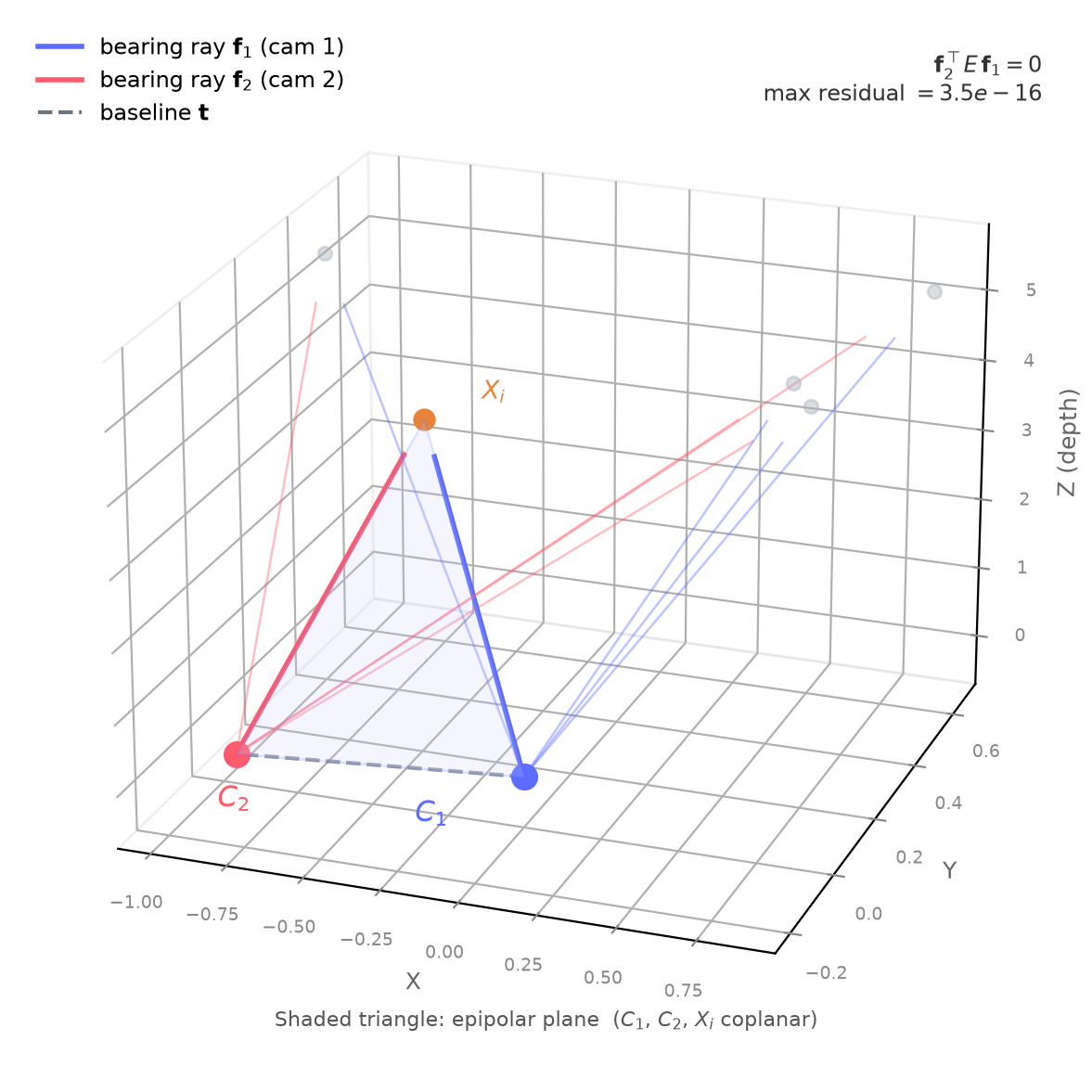
The calibrated epipolar constraint holds on rays, for any central camera:
E is the essential matrix (rank 2). This holds for the unit bearing rays f1, f2 of
pinhole, Double Sphere, Kannala-Brandt, or UCM cameras alike — nothing in it is
pinhole-specific.
A special case, not a different algorithm¶
The pixel-domain version you may have met is a special case. It works only because a pinhole
relates each pixel to its ray through one matrix K.
A fisheye has no such K: its pixel-to-ray map is the curved unproject of Chapters 1–2.
So you do the geometry one step earlier — on the rays themselves — and the same estimator works for a 195° lens.
That is why everything in ds_msp.mvg takes (N, 3) rays.
For why f2ᵀ E f1 = 0 follows from the geometry, and why E has rank 2 with singular
values (1, 1, 0), see Two-view geometry → the epipolar constraint.
3. The eight-point estimator on rays¶
essential_from_rays is the least-squares core: it solves f2ᵀ E f1 = 0 over all
correspondences for the essential matrix E. Measure the fit with epipolar_residual, which
returns f2ᵀ E f1 per pair — zero for a perfect fit.
"""Chapter 8 -- the eight-point estimator on rays, and its epipolar residual.

`essential_from_rays` solves f2^T E f1 = 0 in least squares for the essential matrix
`E`. `epipolar_residual` returns f2^T E f1 per pair -- zero for a perfect fit. Rays are
regenerated with the same recipe as the chapter's opening example (`recover_pose_basic.py`).
"""

import numpy as np

from ds_msp.mvg import essential_from_rays, epipolar_residual


def rodrigues(axis, angle):
    a = np.asarray(axis, float)
    a = a / np.linalg.norm(a)
    K = np.array([[0, -a[2], a[1]], [a[2], 0, -a[0]], [-a[1], a[0], 0]])
    return np.eye(3) + np.sin(angle) * K + (1 - np.cos(angle)) * (K @ K)


def main() -> None:
    rng = np.random.default_rng(1)
    R_true = rodrigues(rng.standard_normal(3), 0.6)
    t_true = rng.standard_normal(3)
    t_true /= np.linalg.norm(t_true)

    X1 = np.column_stack([rng.uniform(-2, 2, 40), rng.uniform(-2, 2, 40), rng.uniform(2, 8, 40)])
    X2 = (R_true @ X1.T).T + t_true
    f1 = X1 / np.linalg.norm(X1, axis=1, keepdims=True)
    f2 = X2 / np.linalg.norm(X2, axis=1, keepdims=True)

    E = essential_from_rays(f1, f2)                 # (3, 3), rank 2
    residual = epipolar_residual(E, f1, f2)         # (40,) algebraic residual, one per pair
    print(f"max epipolar residual: {np.abs(residual).max():.2e}")


if __name__ == "__main__":
    main()
5.69e-16 is float64 round-off (the exact trailing digits vary by platform): on noise-free data
the rays satisfy f2ᵀ E f1 = 0 exactly.
essential_from_rays needs at least 8 correspondences; fewer raises ValueError. It also
takes an optional normalize=True for spherical pre-conditioning.
When normalization helps
normalize=True helps on noisy, narrow-baseline rays, and changes nothing in the noise-free
limit. You don't call it directly in this chapter; the real-data re-fit in
examples/11_two_view_pose_tumvi.py uses it.
4. Decompose and pick the physical pose — the cheirality step¶
An essential matrix does not uniquely give (R, t): it factors into four candidates.
The decomposition splits E = [t]_× R into two possible rotation matrices and two possible
translation directions (±t).
recover_pose builds all four, then applies cheirality to pick the one where the
triangulated points lie in front of both cameras.
Four candidates, one physical pose¶
The four-way split and cheirality selection flow:
graph TD
    E["Essential matrix E<br/>(rank 2)"]
    E --> R1["R candidate 1"]
    E --> R2["R candidate 2<br/>(= R1ᵀ)"]
    R1 --> T1["t direction<br/>(from SVD)"]
    R1 --> T2["−t direction<br/>(sign flip)"]
    R2 --> T3["t direction"]
    R2 --> T4["−t direction"]
    T1 --> C1["Pose 1:<br/>R₁, +t"]
    T2 --> C2["Pose 2:<br/>R₁, −t"]
    T3 --> C3["Pose 3:<br/>R₂, +t"]
    T4 --> C4["Pose 4:<br/>R₂, −t"]
    C1 -.cheirality.-> SEL["Filter λ > 0<br/>for all points"]
    C2 -.cheirality.-> SEL
    C3 -.cheirality.-> SEL
    C4 -.cheirality.-> SEL
    SEL --> OUT["Physical pose<br/>(R, t)"]
    style SEL fill:#ffffcc
    style OUT fill:#ccffcc
The >180° callback (Chapter 3)
"In front" means positive depth along the bearing ray — the scale λ > 0 in
triangulate_rays — not z > 0. A ray past 90° off-axis has a negative z and still
observes a point the lens genuinely sees.
Using z > 0 as the cheirality test would reject every wide-angle correspondence and pick the
wrong one of the four poses.
Chapter 3 made this
point for the validity mask (the z > -w₂·d₁ half-space, valid out to ~227°); cheirality is
the same point, one stage later.
Proving it on a real fisheye camera¶
The §1 demo used hand-made rays. This one drives them through a real wide-FOV camera model —
DoubleSphereModel — to prove the pipeline is genuinely model-agnostic.
The steps: project 3D points to fisheye pixels in two views, unproject back to rays, recover the pose.
This mirrors tests/mvg/test_two_view.py::test_recover_pose_through_a_real_double_sphere_camera
exactly, so the number is asserted in CI. Here is
the complete round-trip:
"""Chapter 8 -- two-view pose recovery through a real Double Sphere fisheye camera.

Projects 3D points to fisheye pixels in two views, unprojects back to rays, and
recovers the pose with `recover_pose` -- proving the pipeline is model-agnostic. This
mirrors `tests/mvg/test_two_view.py::test_recover_pose_through_a_real_double_sphere_camera`.
"""

import numpy as np

from ds_msp.models import DoubleSphereModel
from ds_msp.mvg import recover_pose


def rodrigues(axis, angle):
    a = np.asarray(axis, float)
    a = a / np.linalg.norm(a)
    K = np.array([[0, -a[2], a[1]], [a[2], 0, -a[0]], [-a[1], a[0], 0]])
    return np.eye(3) + np.sin(angle) * K + (1 - np.cos(angle)) * (K @ K)


def rot_err_deg(A, B):
    return np.degrees(np.arccos(np.clip((np.trace(A.T @ B) - 1) / 2, -1, 1)))


def dir_err_deg(a, b):
    a, b = a / np.linalg.norm(a), b / np.linalg.norm(b)
    return np.degrees(np.arccos(np.clip(abs(a @ b), -1, 1)))


def main() -> None:
    cam = DoubleSphereModel(fx=300.0, fy=300.0, cx=320.0, cy=320.0, xi=0.3, alpha=0.6)
    rng = np.random.default_rng(7)
    R_true = rodrigues(rng.standard_normal(3), 0.5)
    t_true = rng.standard_normal(3)
    t_true /= np.linalg.norm(t_true)

    X1 = np.column_stack([rng.uniform(-3, 3, 60), rng.uniform(-3, 3, 60), rng.uniform(2, 9, 60)])
    X2 = (R_true @ X1.T).T + t_true

    uv1, ok1 = cam.project(X1)            # 3D -> fisheye pixels, view 1; ok1: (60,) valid mask
    uv2, ok2 = cam.project(X2)            # 3D -> fisheye pixels, view 2
    ok = ok1 & ok2
    f1, _ = cam.unproject(uv1[ok])        # pixels -> unit rays, view 1
    f2, _ = cam.unproject(uv2[ok])        # pixels -> unit rays, view 2

    R, t, X = recover_pose(f1, f2)
    print(f"valid pairs          : {int(ok.sum())}")
    print(f"rotation error       : {rot_err_deg(R_true, R):.2e} deg")
    print(f"translation-dir error: {dir_err_deg(t_true, t):.2e} deg")


if __name__ == "__main__":
    main()
Rotation error ~1.2e-6°, translation-direction error ~0° — well under the 1e-3° the
test asserts. The pose is exact to the precision of the camera's project/unproject round-trip.
The two-view geometry adds no error of its own. Notice that mvg never learns it was looking
at a fisheye: it only ever saw rays. That is the payoff of working on bearings.
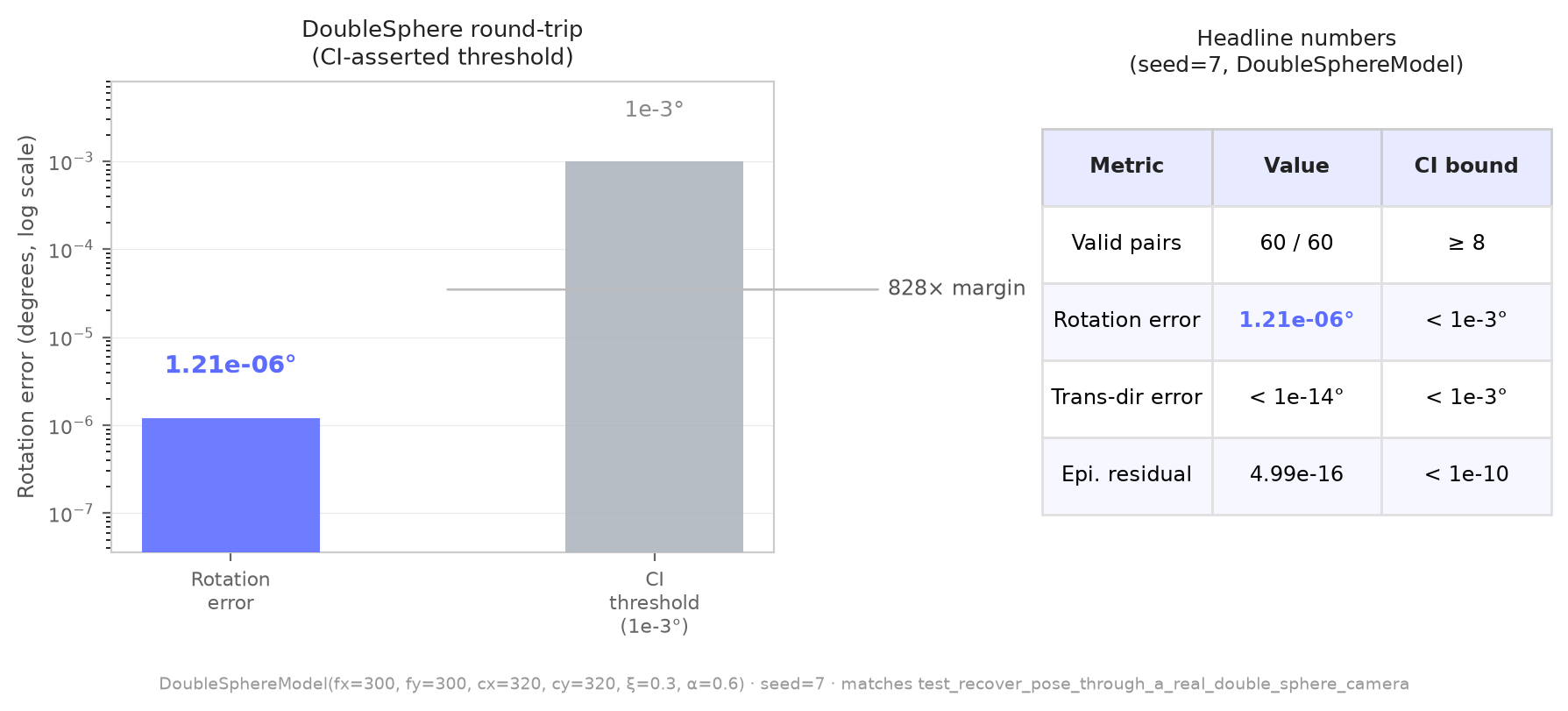
Notice too that all 60 pairs survive the ok mask. Every point here falls inside the
lens's valid cone (the
Chapter 3 half-space),
so project flags none of them invalid and the mask filters nothing.
Spread the scene wider — past the θ_max boundary Chapter 3 measures — and some points would
drop out, leaving fewer than 60 pairs. The pipeline handles that for free: it only ever feeds
the surviving rays to recover_pose.
For the proof that exactly four decompositions exist and why cheirality selects one, see Two-view geometry → decomposing the essential matrix.
5. Make it robust: RANSAC against wrong matches¶
The eight-point estimator is least-squares, so a handful of mismatched rays — inevitable from a real feature matcher — drag the whole fit off.
ransac_relative_pose wraps the estimator in RANSAC:
it samples minimal sets, scores each candidate E by how many correspondences fit, and re-fits
on the consensus.
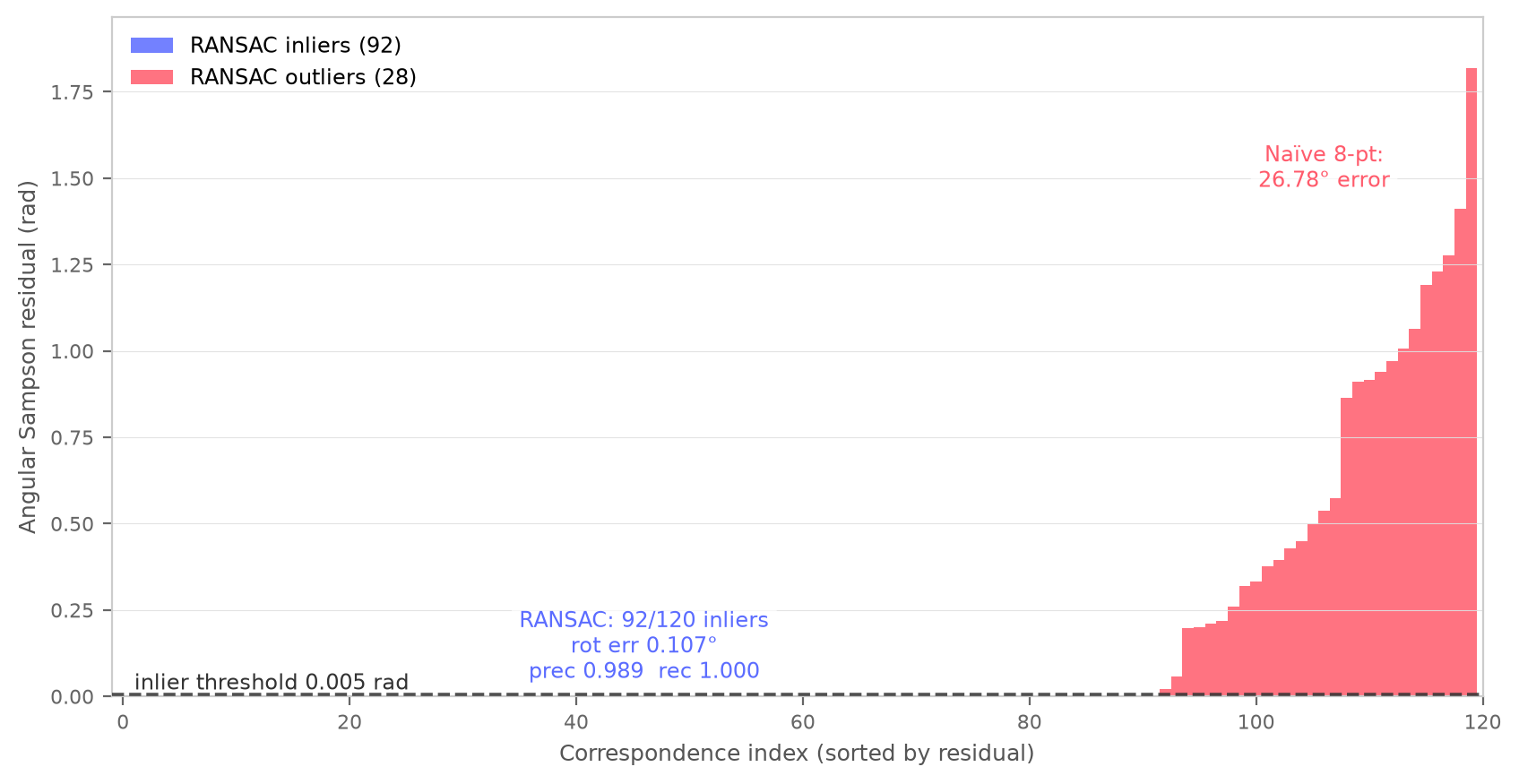
It scores with a Sampson distance on the sphere, which is an angle in radians. The inlier threshold is FOV-independent — the right currency for a fisheye, where a pixel threshold means different angles at the centre and the rim.
Corrupt 30% of the matches¶
Corrupt 30% of the matches and compare the naïve eight-point against RANSAC. The following self-contained snippet shows the difference:
"""Chapter 8 -- RANSAC against wrong matches, vs. the naive eight-point.

Corrupts 30% of camera-2 rays with random directions (the "wrong matches"), then
compares the naive least-squares eight-point against `ransac_relative_pose`, which
scores candidates by the angular Sampson residual on the sphere.
"""

import numpy as np

from ds_msp.mvg import recover_pose, essential_from_rays, ransac_relative_pose


def rodrigues(axis, angle):
    a = np.asarray(axis, float)
    a = a / np.linalg.norm(a)
    K = np.array([[0, -a[2], a[1]], [a[2], 0, -a[0]], [-a[1], a[0], 0]])
    return np.eye(3) + np.sin(angle) * K + (1 - np.cos(angle)) * (K @ K)


def rot_err_deg(A, B):
    return np.degrees(np.arccos(np.clip((np.trace(A.T @ B) - 1) / 2, -1, 1)))


def dir_err_deg(a, b):
    a, b = a / np.linalg.norm(a), b / np.linalg.norm(b)
    return np.degrees(np.arccos(np.clip(abs(a @ b), -1, 1)))


def main() -> None:
    rng = np.random.default_rng(3)
    R_true = rodrigues(rng.standard_normal(3), 0.6)
    t_true = rng.standard_normal(3)
    t_true /= np.linalg.norm(t_true)
    X1 = np.column_stack([rng.uniform(-2, 2, 120), rng.uniform(-2, 2, 120), rng.uniform(2, 8, 120)])
    X2 = (R_true @ X1.T).T + t_true
    f1 = X1 / np.linalg.norm(X1, axis=1, keepdims=True)
    f2 = X2 / np.linalg.norm(X2, axis=1, keepdims=True)

    # Corrupt 30% of camera-2 rays with random directions (the "wrong matches").
    rng2 = np.random.default_rng(4)
    outlier = rng2.random(120) < 0.30
    f2_bad = f2.copy()
    f2_bad[outlier] = rng2.standard_normal((int(outlier.sum()), 3))
    f2_bad /= np.linalg.norm(f2_bad, axis=1, keepdims=True)

    # Naive eight-point on the contaminated rays:
    R_naive, _, _ = recover_pose(f1, f2_bad, essential_from_rays(f1, f2_bad))

    # Robust: RANSAC with a 0.005 rad (~0.3 deg) angular inlier threshold.
    R_rob, t_rob, inliers = ransac_relative_pose(f1, f2_bad, threshold=0.005, seed=0)

    truth = ~outlier
    precision = (inliers & truth).sum() / max(inliers.sum(), 1)
    recall = (inliers & truth).sum() / truth.sum()

    print(f"naive  rotation error : {rot_err_deg(R_true, R_naive):.2f} deg")
    print(f"RANSAC rotation error : {rot_err_deg(R_true, R_rob):.3f} deg")
    print(f"RANSAC trans-dir error: {dir_err_deg(t_true, t_rob):.3f} deg")
    print(f"inlier precision/recall: {precision:.3f} / {recall:.3f}  ({int(inliers.sum())}/120)")


if __name__ == "__main__":
    main()
Naïve vs. robust¶
Here is a summary of how RANSAC recovers from 30% corrupted matches:
| Metric | Naïve eight-point | RANSAC |
|---|---|---|
| Rotation error | 26.78° | 0.107° |
| Translation-direction error | — | 0.274° |
| Inlier precision | — | 0.989 |
| Inlier recall | — | 1.000 |
The naïve fit is ~27° off — useless. RANSAC recovers rotation to 0.107° and the translation direction to 0.274°.
Inlier precision 0.989 / recall 1.000: it found every one of the ~91 good matches and admitted almost no bad ones.
The thresholds asserted in tests/mvg/test_ransac.py are rotation < 0.5°, translation-direction
< 2.0°, precision > 0.95, recall > 0.9 — all met with margin.
Watch this as outliers rise
RANSAC's iteration budget tracks the inlier ratio: the fraction of random 8-samples that land all inliers drops fast as outliers rise. Push exercise 2's outlier fraction up to see it.
At very low inlier ratios the default max_iters=1000 may never draw a clean 8-sample, and
recall collapses. Raising max_iters buys back some headroom.
6. On real data: a TUM-VI fisheye pair¶
Synthetic rays are noise-free; real ones are not. The companion example
examples/11_two_view_pose_tumvi.py
runs the exact same pipeline on two real TUM-VI room1 fisheye frames.
It KLT-tracks features between them (reusing the
tracker from examples/09),
unprojects both pixel sets through the loaded calibrated model to rays, and runs
ransac_relative_pose.
Run the example¶
$ python examples/11_two_view_pose_tumvi.py --start 400 --gap 4
camera: KannalaBrandtModel  fx=190.98 cx=254.93
frames 400 -> 404: 22 KLT matches
valid bearing pairs: 22 / 22

RANSAC relative pose (20 inliers / 22 = 90.9%):
  inlier Sampson residual: median 2.01e-02 rad  max 2.59e-02 rad  (~1.149 deg)
  recovered |t| direction vs mocap baseline: ~108.3 deg (coarse; camera != world frame)
End-to-end on real fisheye
The pipeline runs on a real TUM-VI fisheye stream. Only 22 KLT matches survive this particular
4-frame gap (low-texture frames; try --start 700 for ~80).
RANSAC keeps 20 of 22 (90.9% inliers) with a median angular residual of ~0.02 rad
(~1.1°) — an order of magnitude looser than the synthetic exercise's 5.69e-16, because real
KLT corners on a real fisheye carry real subpixel noise. The pipeline still recovers one
consistent pose from noisy, real measurements — that consistency, not machine-precision
agreement, is the point on real data.
Demonstration, not a guarantee
The deterministic correctness claim is the synthetic round-trip in §4 (< 1e-3°, asserted in
CI). On real data the translation direction check against the mocap baseline is only coarse.
The recovered t lives in the camera frame, the mocap baseline in the world/body frame, and
there's an unknown camera-to-body rotation on top of the lever arm — so don't read the ~108°
as pose error.
With no extrinsic correction applied, this raw angle mixes the real recovered motion with an arbitrary frame offset. It isn't meant to look small — it's a placeholder for the frame-aligned check Chapter 9 builds toward, which is where a genuinely tight number belongs.
A different model, same code
The camera printed as KannalaBrandtModel, not Double Sphere — that's the model TUM-VI ships
in its calibration file. The two-view code didn't care: it only ever saw rays. That's §2's
model-agnostic claim, demonstrated on a different model than §4 used.
Try it yourself¶
Predict first, then run. The exercises below ask you to change one parameter and observe how it affects the pose estimate:
- Vary the rotation magnitude. In §1, change
0.6inrodrigues(rng.standard_normal(3), 0.6)to0.05(a tiny rotation, almost no parallax). Predict first: does the error grow or stay near zero?
Then add noise — f2 += 1e-3 * rng.standard_normal(f2.shape) — and re-run.
Small-baseline two-view geometry is ill-conditioned. Watch the error climb far faster at
0.05 than at 0.6.
2. Push the outlier fraction. In §5, raise 0.30 to 0.50, then 0.70. Predict where
RANSAC's recall collapses before you run it.
3. Move the real pair apart. Run examples/11_two_view_pose_tumvi.py with --gap 1 (tiny
baseline) and --gap 12 (large baseline, fewer surviving tracks). Which gives the lower
Sampson residual, and why is the tiny-baseline case noisier even with more matches?
Recap and next step¶
You recovered relative pose from bearing rays with recover_pose, and proved it exact on a
synthetic Double Sphere scene (~1e-6°, CI-asserted < 1e-3°).
You made it robust with ransac_relative_pose (0.107° under 30% outliers).
You then ran the whole thing on a real TUM-VI fisheye pair (~90.9% inliers, ~1.1° residual). That's an order of magnitude looser than the synthetic exercises, because real KLT corners carry real subpixel noise.
The pose here is a closed-form two-view estimate. The next step is to refine it.
refine_two_view runs iterative Levenberg–Marquardt on the rotation–translation manifold
(SO(3) × S²), minimizing angular reprojection error to drive the residual below what the
one-shot estimate reaches.
That closed-form pose becomes the seed, and the same machinery extends to chains of poses and
points — full bundle adjustment. That's Chapter 9 — manifold optimization
(ds_msp.mvg.refine_two_view).