Chapter 3 — Projection validity & the >180° cone
Run alongside this:
python examples/07_fov_and_validity.py(after the setup). Read this, then read the printed numbers.
A fisheye lens sees more than a hemisphere — past 90° off-axis, even slightly behind the camera. That's the whole point of it.
But it raises a question almost no tutorial answers clearly: exactly where does "the camera can see this" end? This chapter draws that boundary and puts a number on it.
It's also the reason a rectified fisheye image always has a black border.
You'll learn
- Why z > 0 is the classic fisheye validity bug, and the correct test: a tilted
half-space z > -w₂·d₁ (Usenko et al. 2018, Eq. 43–45).
- Measure the actual valid cone of a real Double Sphere calibration:
θ_max = 113.4°, i.e. a 227° total field of view — not the 180° a z > 0 test
would give you.
- Why a rectified pinhole view can never keep that whole cone, and how the balance knob
trades field of view against black border (147.0° / 92.5% filled at balance=0 vs.
118.7° / 100% filled at balance=1).
Prerequisites
- Finish Chapter 1 (undistortion and the balance
knob) and Chapter 2 (the ξ, α parameters this
chapter's half-space test is built from).
- Same setup as Chapters 1–2; no new installs.
1. The boundary nobody draws
Here is the camera's world from directly above — the XZ plane, camera at the origin
looking along +Z:
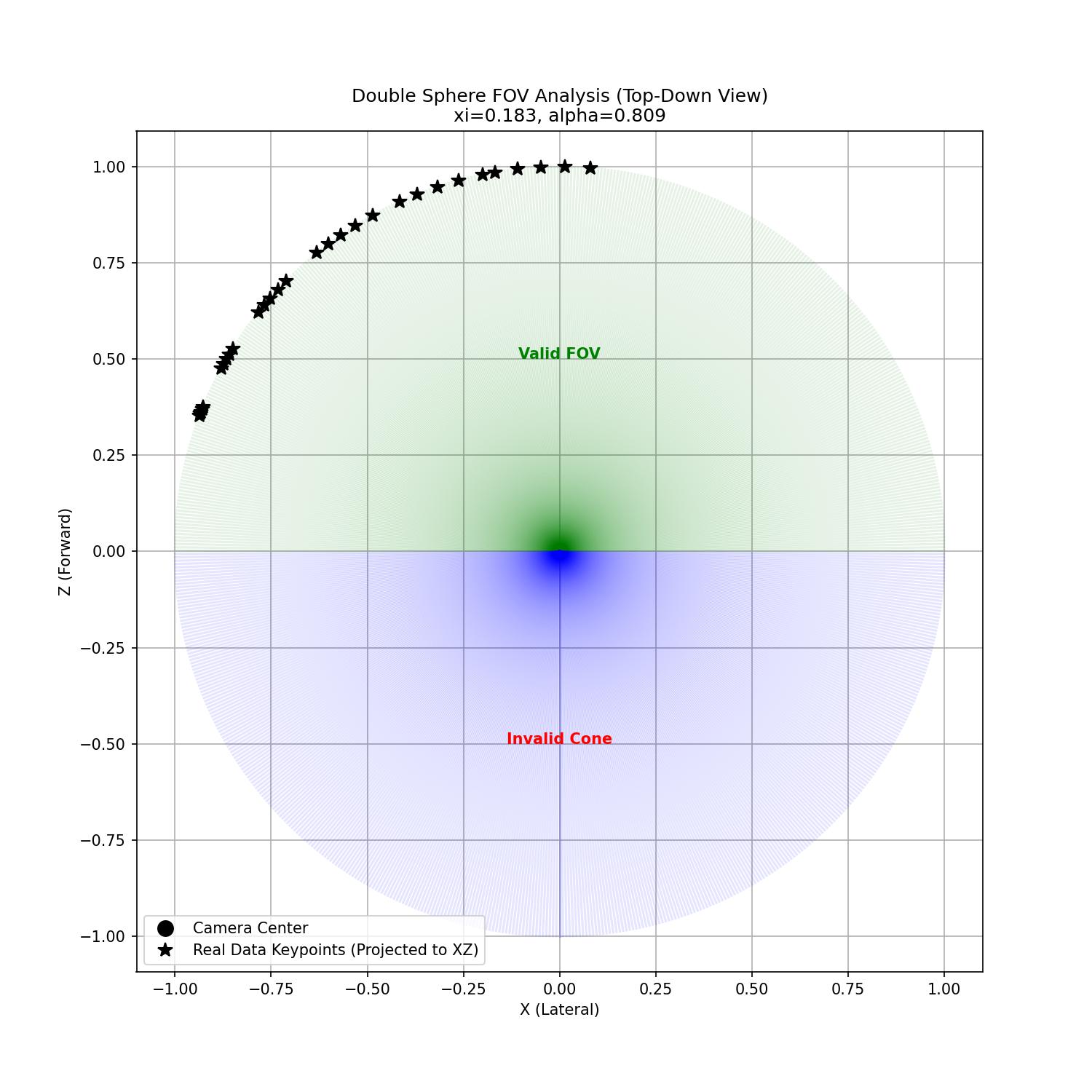
- Green — where the model can project a ray to a pixel.
- Blue — the invalid cone it cannot reach.
The black stars are real calibration keypoints. Notice they arc well past the X-axis
(90°), into rays pointing slightly backward (z < 0) — and are still green.
Note
A pinhole camera's valid region is only the top half (z > 0). A fisheye's valid region
is much larger — that gap is exactly what this chapter puts a number on.
2. The validity test is a half-space — not z > 0
The naive guess for "can the camera see this point?" is z > 0 — is it in front? For a
fisheye, that guess is wrong.
It's the single most common implementation bug: it silently throws away every ray past 90°, capping a >180° lens at exactly 180°.
The correct test (Usenko et al. 2018, Eq. 43–45), implemented in
ds_msp/models/ds_math.py, is a tilted
half-space:
where w₂ is a constant built from the model's α and ξ. For a unit-length ray
(d₁ = 1) at incidence angle θ, z = cos θ — so the test becomes simply cos θ > −w₂.
Every ray out to
is valid. Here's that computed directly, plus a numeric check that sweeps 4000 rays and
asks the model itself which ones it accepts, for the original calibration
(ξ=0.183, α=0.809):
"""Chapter 3 -- the Double Sphere valid-ray half-space (Usenko et al. 2018, Eq. 43-45).

For a unit-length ray at incidence angle theta, the half-space test z > -w2*d1
collapses to cos(theta) > -w2, so theta_max = arccos(-w2) is the widest ray the
model accepts. This checks that analytic value against a brute-force sweep.
"""

import json

import numpy as np

from ds_msp import DoubleSphereCamera


def main() -> None:
    intr = json.load(open("test_config.json"))["intrinsics"]  # the bundled real calibration
    cam = DoubleSphereCamera(intr["fx"], intr["fy"], intr["cx"], intr["cy"],
                             intr["xi"], intr["alpha"],
                             width=intr["width"], height=intr["height"])
    xi, alpha = cam.xi, cam.alpha
    print(f"xi={xi:.4f}, alpha={alpha:.4f}")

    # analytic: for a unit ray (d1=1) the half-space test z > -w2*d1 becomes cos(theta) > -w2
    w1 = (1 - alpha) / alpha if alpha > 0.5 else alpha / (1 - alpha)
    w2 = (w1 + xi) / np.sqrt(2 * w1 * xi + xi * xi + 1.0)
    theta_max = np.degrees(np.arccos(-w2))
    print(f"w2 = {w2:.4f}, theta_max = {theta_max:.1f} deg")

    # numeric check: sweep rays from 0 to 180 deg, ask the model which ones it accepts
    thetas = np.linspace(0, np.pi, 4000)
    rays = np.stack([np.sin(thetas), np.zeros_like(thetas), np.cos(thetas)], axis=1)
    _, valid = cam.project(rays)
    numeric_theta_max = np.degrees(thetas[valid].max())
    print(f"numeric check: {numeric_theta_max:.1f} deg")
    print(f"total field of view: {2 * theta_max:.0f} deg")


if __name__ == "__main__":
    main()
113.4°, not 90° — the camera accepts rays 23° behind its own side. The analytic value matches a brute-force sweep of 4000 rays to the first decimal, so the formula is right.
A z > 0 test would have stopped at 90° and quietly discarded a quarter of the lens.
3. The same cone, painted onto a real frame
The top-down diagram shows the geometry. Here's that same valid region mapped onto a real fisheye image:
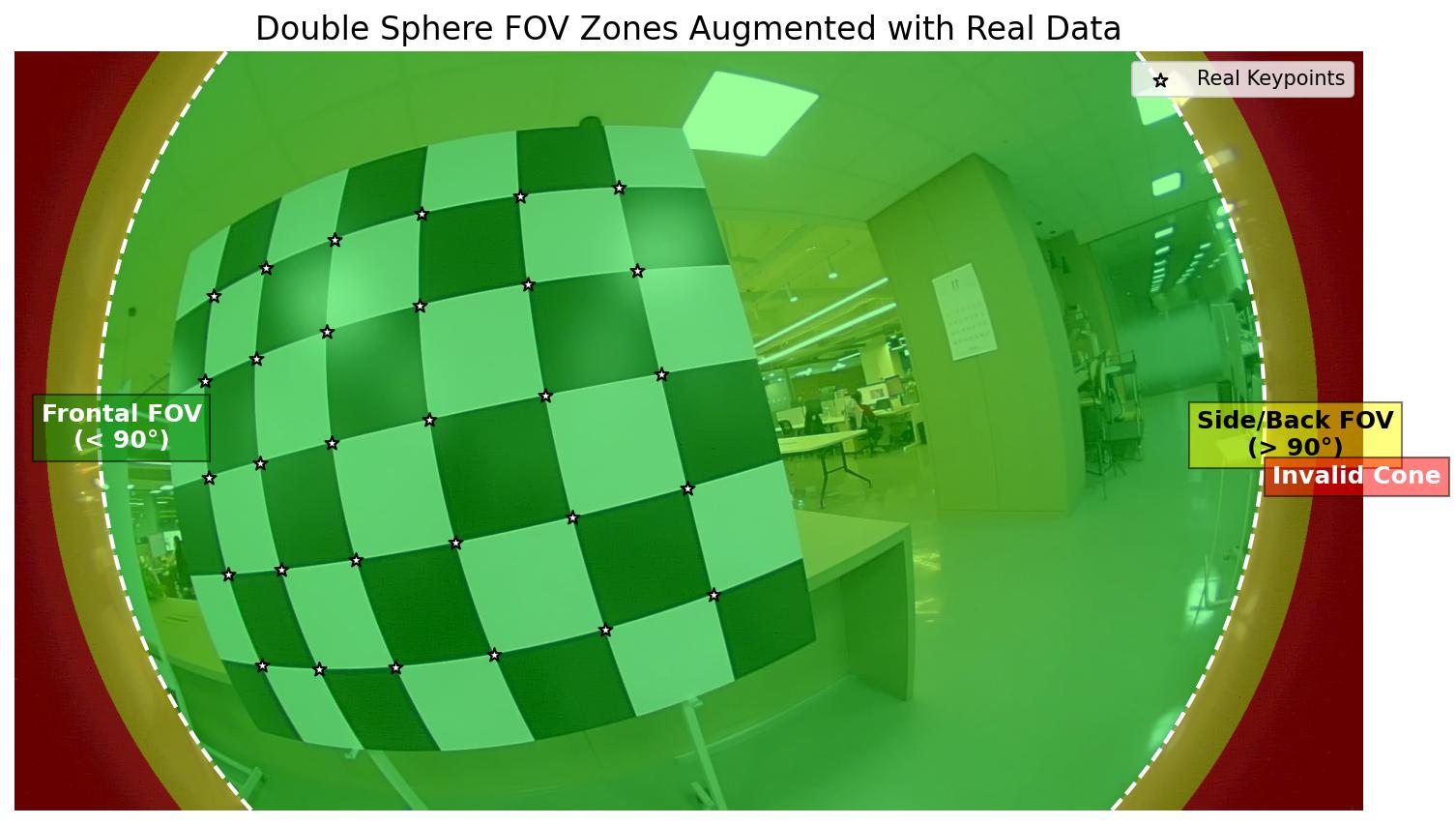
- Green — frontal (
θ < 90°): ordinary forward rays; a pinhole could handle these. - Yellow — side/back (
90° ≤ θ < θ_max): valid in Double Sphere (z ≤ 0!), but impossible to put into a single pinhole image. These are the rays the naive bug drops. - Red — the invalid cone (
θ ≥ θ_max): outside the model's domain entirely. - White stars: the real calibration keypoints — all safely inside the valid region.
This is the picture to keep in your head: "in front of the camera" (pinhole) is a small green disc inside the much larger green-plus-yellow region a fisheye actually sees.
4. Why you can't undistort it all away
If the lens sees 227°, why does the rectified "pinhole view" always cut some of it off?
Because a pinhole image plane is infinite at 90°: a ray at exactly 90° projects to
x/z → ∞.
There is no finite image that holds the yellow zone. Those pixels aren't lost to a bug — they are geometrically un-pinhole-able.
The balance trade-off
Rectification forces a trade instead, controlled by the balance knob. The sweep below
runs five settings, from widest field of view to a fully filled frame:
"""Chapter 3 -- the `balance` knob trades rectified field of view for black border.

A pinhole image plane is infinite at 90 degrees, so a Double Sphere lens's >180 deg
field of view can never fit into one rectified frame without cropping. `balance`
controls where on that trade-off the output sits.
"""

import json

import cv2
import numpy as np

from ds_msp import DoubleSphereCamera


def main() -> None:
    intr = json.load(open("test_config.json"))["intrinsics"]  # the bundled real calibration
    cam = DoubleSphereCamera(intr["fx"], intr["fy"], intr["cx"], intr["cy"],
                             intr["xi"], intr["alpha"],
                             width=intr["width"], height=intr["height"])

    img = cv2.imread("assets/test_image.jpg")   # the bundled real fisheye frame
    for b in [0.0, 0.25, 0.5, 0.75, 1.0]:
        K_new = cam.compute_K_new(balance=b)
        rect, _ = cam.undistort_image(img, K_new)
        hfov = np.degrees(2 * np.arctan((cam.width / 2) / K_new[0, 0]))
        filled = float((cv2.cvtColor(rect, cv2.COLOR_BGR2GRAY) > 0).mean()) * 100
        print(f"balance={b:.2f}  hfov={hfov:.1f} deg  filled={filled:.1f}%")


if __name__ == "__main__":
    main()
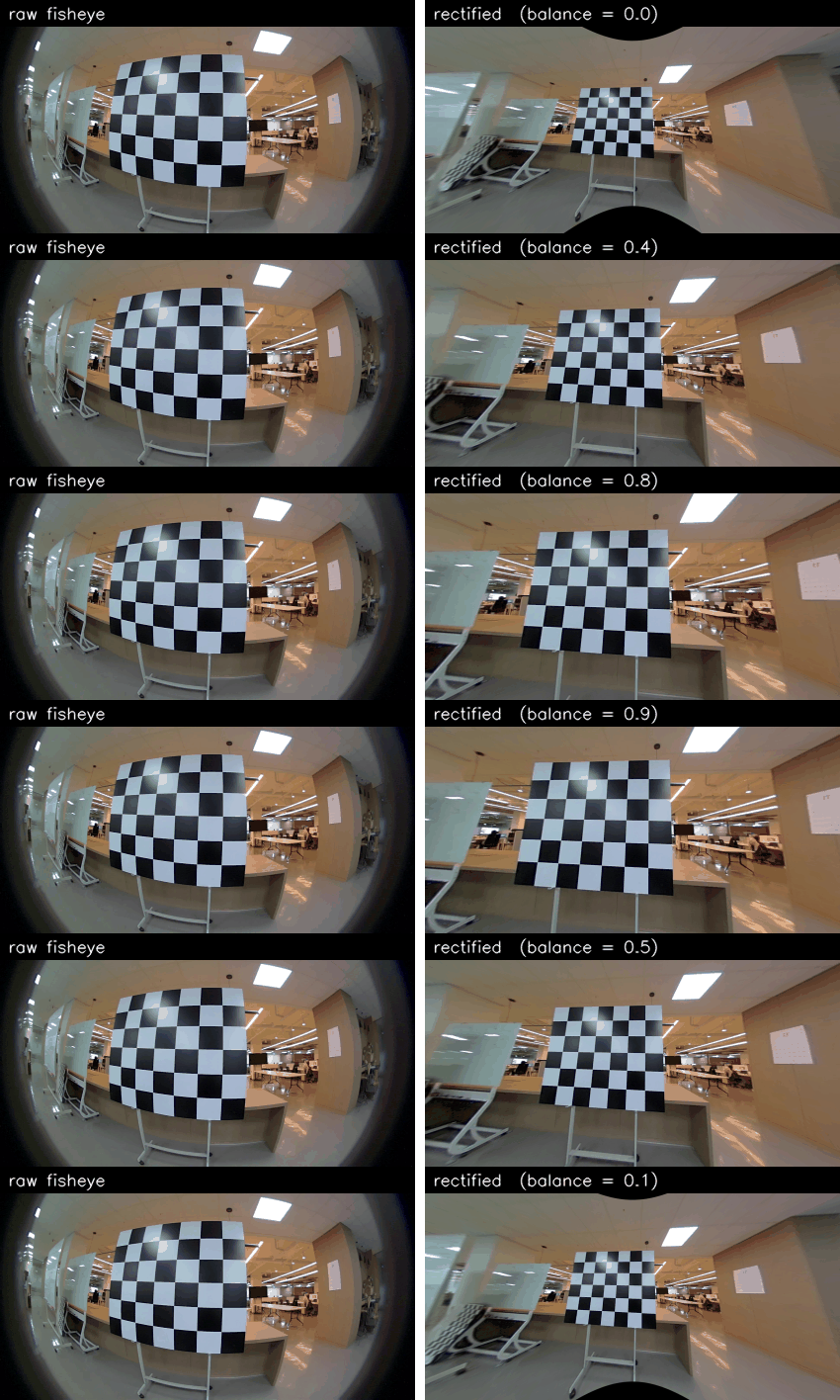
balance = 0keeps the widest view (147° here) but leaves a black border — the corners of the output map to rays the source frame never captured.balance = 1crops until the frame is 100% filled, but throws ~30° of field of view away.
The coverage footprint
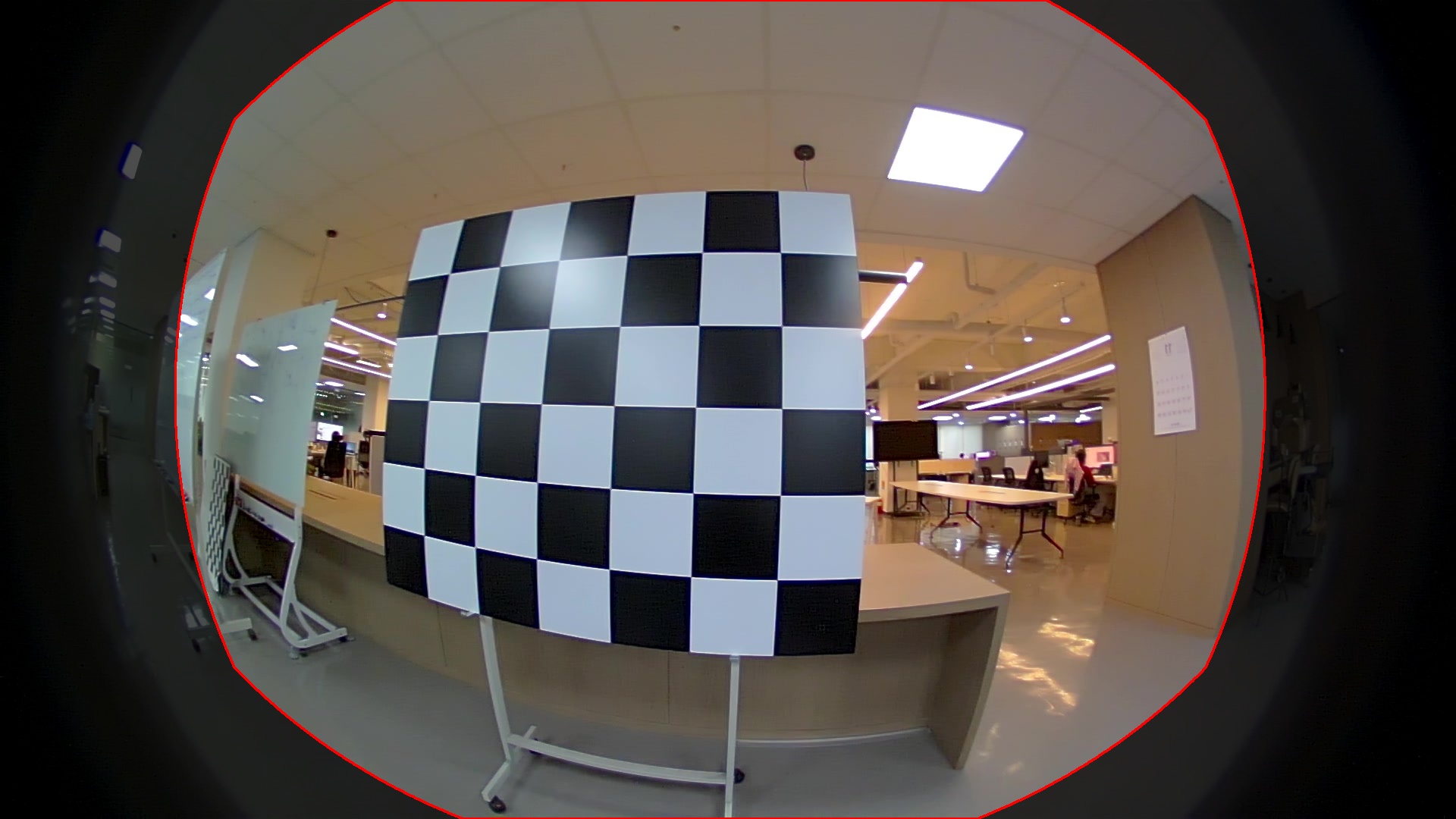
The original "coverage" frame below makes the same point from the other direction. The red circle is the lens's actual image footprint.
Everything outside it (the dark corners) is sensor with no light — which is why a flat rectification can never fill those corners without zooming in:
5. What you can now reason about
- A fisheye's "can I see it?" test is a tilted half-space
z > −w₂·d₁, notz > 0. - That half-space corresponds to a valid cone wider than a hemisphere — here 227°.
- Undistortion to a pinhole cannot keep the part past 90°, so
balancetrades field of view against black border; you choose where on that curve to sit.
Try it yourself
- Re-run the example after editing
test_config.jsonto setalpha = 0.5. Predict whetherθ_maxgrows or shrinks before you look. (Hint: atα ≤ 0.5the model degenerates toward UCM andw₂changes piecewise.) - Add a
balance = -0.5row to the sweep. What happens to the hFOV and the fill percentage? - Project a single ray at exactly
θ = 113°and atθ = 114°and check thevalidmask — you've found the edge of the cone by hand.
Next: Chapter 4 — analytic Jacobians vs autodiff: derive the
projection's exact derivative and gradient-check it. (coming soon — see
../ROADMAP.md)