🏆 Capstone — calibrate a real fisheye camera, and match the published numbers
Run alongside this
pip install -e .[calib] then python examples/03_calibrate_tumvi_aprilgrid.py
(after the setup).
Everything else in this curriculum is practice for one claim:
Give me raw footage of a camera looking at a calibration board, and I will recover its lens parameters from scratch — and they will agree with the numbers the experts published.
No convert(), no loading someone's answer. Detect the corners, bundle-adjust the geometry,
compare to truth.
We use TUM-VI's cam0 calibration sequence — 436 frames of someone waving a 6×6 AprilGrid
in front of a 195° fisheye — and check our result against the Kannala-Brandt calibration
the dataset authors published.
You'll learn
- Calibrate a Kannala-Brandt camera from scratch — detect real AprilGrid corners,
bundle-adjust intrinsics and a per-frame pose with ds_msp.calib.calibrate, and compare
the result to TUM-VI's published reference number-for-number.
- Land on 0.080 px median reprojection (0.160 px inlier RMS) over all 14,460
self-detected corners, with focal length matching the published value to ~0.02%.
- Diagnose a real "detector returns 0 tags on every frame" bug — a 2-cell vs. 1-cell
AprilTag border mismatch between Kalibr-style boards and stock AprilTag-3 — and fix it.
- See why the Double Sphere model fits the very same corners just as tightly (~0.08 px)
even though its raw focal number (fx≈249) looks nothing like KB's (fx≈191) — until you
correct for DS's own focal gauge.
Prerequisites - Finish Chapter 2 — the capstone is runnable right after it; Chapters 3+ are optional theory, not required. - Install the calibration extra and the dataset:
(see the project setup for details).
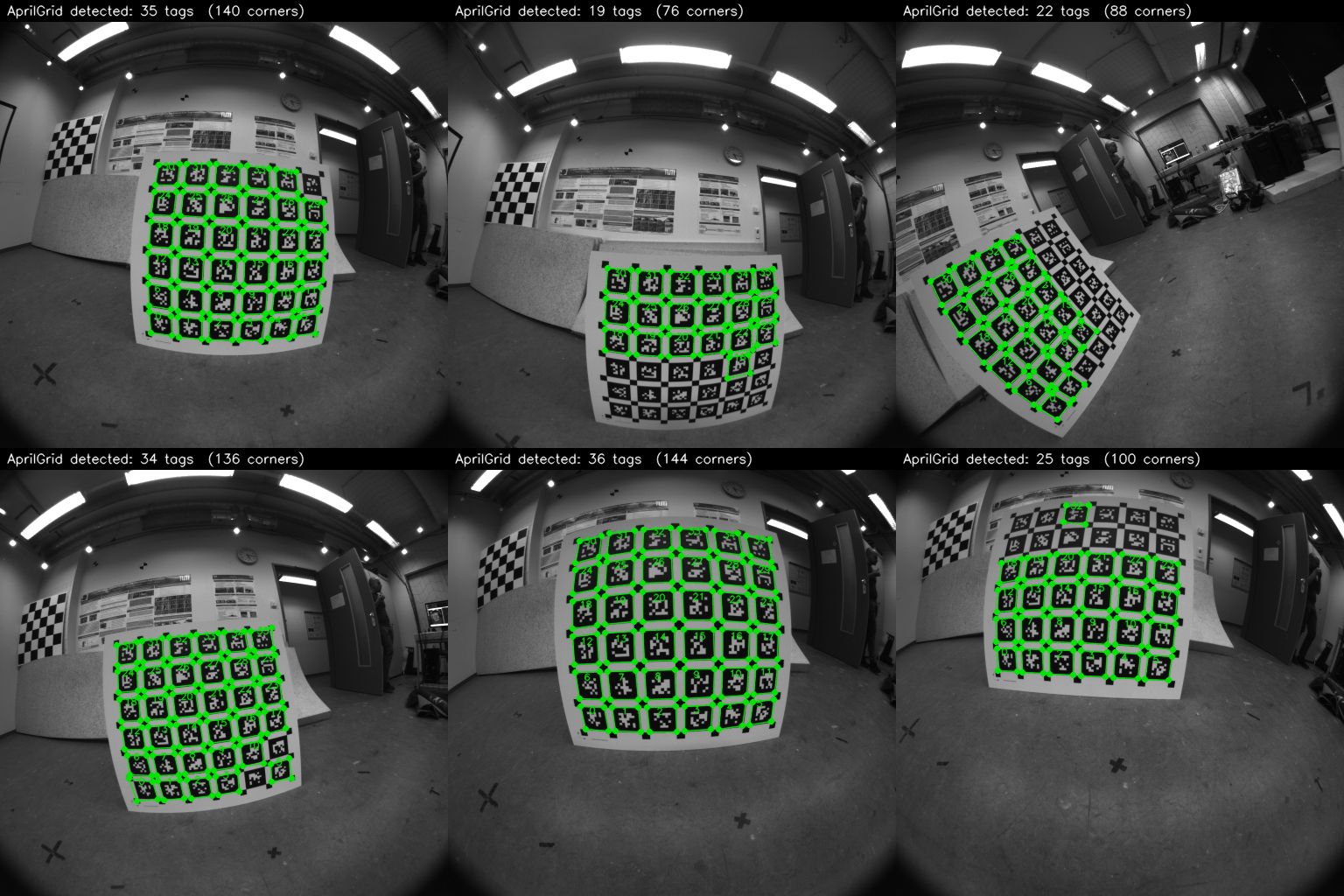
Step one, on real data: the AprilGrid detector finds the board's tags (here ~35 of 36) and their corners in each fisheye frame. Those corners are the measurements we calibrate from.
The pipeline (all library code)
graph LR
    A["raw frames"] --> B["detect AprilGrid<br/>detect_aprilgrid()"]
    B --> C["3D↔2D correspondences<br/>AprilGridTarget"]
    C --> D["bundle-adjust<br/>calibrate()"]
    D --> E["compare to<br/>published reference"]
Four steps, one call each
- Detect the board corners —
ds_msp.calib.detect_aprilgrid(the one piece that needs a tag backend; see the war-story below). - Correspond —
ds_msp.calib.AprilGridTargetknows where every tag corner sits in 3D board metres, so a detectedtag_idbecomes a(X,Y,Z) ↔ (u,v)pair. - Calibrate —
ds_msp.calib.calibratejointly refines the 6/8 intrinsics and a pose per frame by Levenberg-Marquardt, using each model's analytic projection Jacobian (Chapter 4's payoff: no finite differences, no autodiff). - Compare — line our
fx, fy, cx, cy, k1..k4up against the published reference.
We calibrate a Kannala-Brandt model precisely because TUM-VI's published reference is KB — so the comparison is number-for-number, not hand-waving.
The code, trimmed
Here are those four steps as real, runnable code — the actual pipeline
examples/03_calibrate_tumvi_aprilgrid.py
runs, trimmed of argument parsing and print formatting:
import glob, os
from ds_msp.calib import AprilGridTarget, calibrate, detect_aprilgrid
from ds_msp.io.kalibr import load_kalibr_with_resolution
from ds_msp.models import KannalaBrandtModel

CALIB_DIR = "datasets/tumvi/dataset-calib-cam1_512_16/mav0/cam0/data"
CAMCHAIN = "datasets/tumvi/dataset-room1_512_16/dso/camchain.yaml"

# 1. detect -- multi-scale by default (scales=(1, 2, 3)), so peripheral tags the
#    fisheye shrinks below a single-scale detector's size gate are still recovered.
paths = sorted(glob.glob(os.path.join(CALIB_DIR, "*.png")))
detections = detect_aprilgrid(paths, family="t36h11", min_tags=6, refine=True)

# 2. correspond -- board geometry -> (X,Y,Z world) <-> (u,v pixel) pairs.
target = AprilGridTarget(tag_rows=6, tag_cols=6, tag_size=0.088, tag_spacing=0.3)
Xs, UVs, VIs = target.build_correspondences(detections, min_corners=8)

# 3. calibrate -- a generic seed, NOT the published answer; Cauchy keeps every
#    corner but down-weights outliers instead of discarding them.
seed = KannalaBrandtModel(fx=180.0, fy=180.0, cx=256.0, cy=256.0)
result = calibrate(seed, Xs, UVs, VIs, loss="cauchy", f_scale=0.5)
model = result["model"]

# 4. compare -- against TUM-VI's own published Kalibr camchain for this camera.
published, (w, h) = load_kalibr_with_resolution(CAMCHAIN, cam="cam0")
print(model)                    # KannalaBrandtModel(fx=191.007, fy=190.994, ...)
print(published)                # KannalaBrandtModel(fx=190.978, fy=190.973, ...)
print(f"median reprojection: {result['median_px']:.3f} px")   # 0.080 px
Every number quoted in this chapter comes straight from running this (the full script also prints the per-parameter delta table and repeats the fit with Double Sphere — see below).
The result
Numbers
$ python examples/03_calibrate_tumvi_aprilgrid.py
            fx        fy        cx        cy        k1        k2        k3        k4
published  190.978   190.973   254.932   256.897   0.00348   0.00072  -0.00205   0.00020
mine       191.019   191.006   254.949   256.860   0.00641  -0.00491   0.00171  -0.00059
|Δ|          0.041     0.033     0.018     0.037

median reprojection 0.080 px, inlier RMS 0.160 px — over all 14460 corners we
detected ourselves, none discarded.
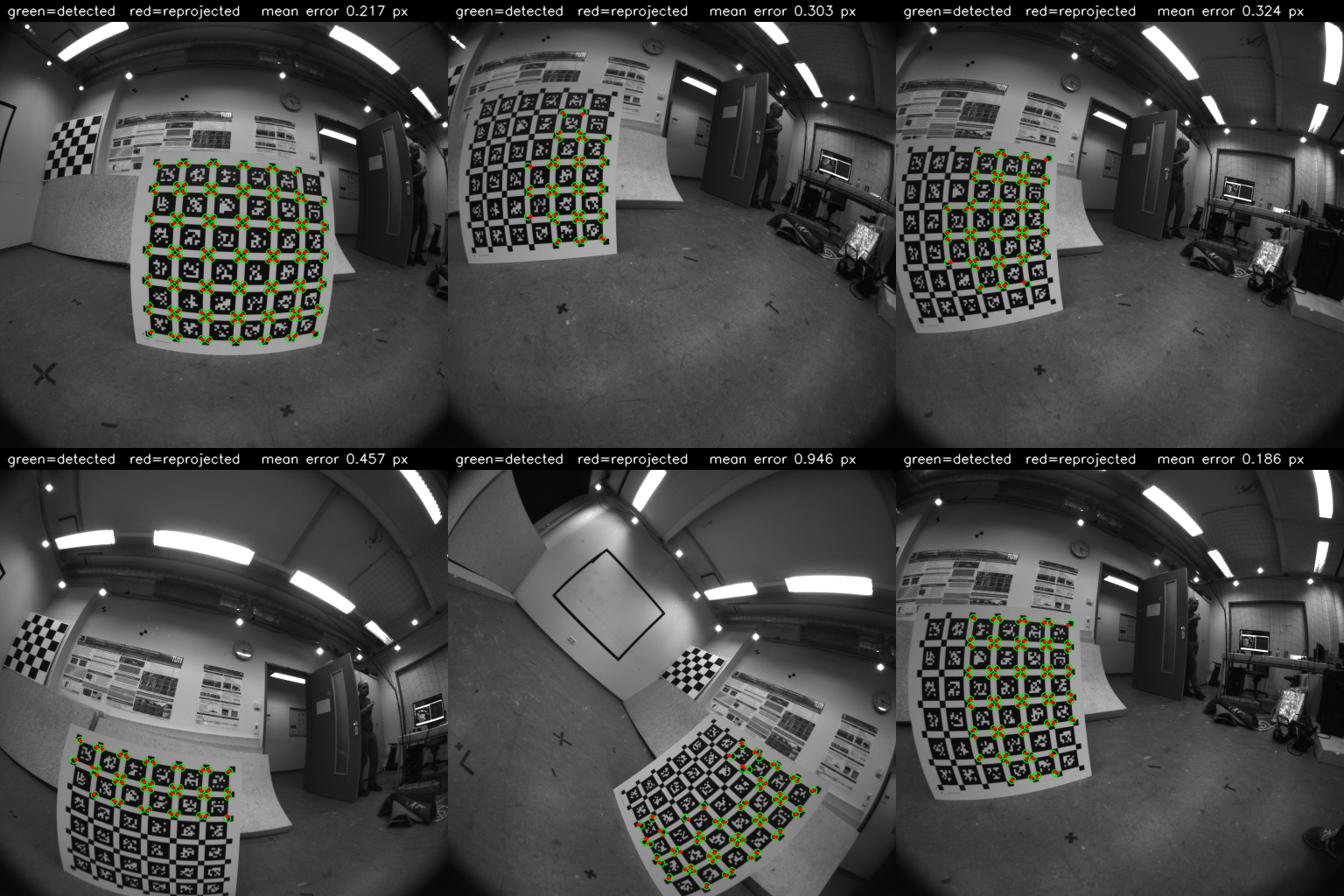
What "0.1 px" looks like: green = the corners we detected, red = where the calibrated model predicts they should be. They sit on top of each other in every frame — the model reproduces the measurements to a tenth of a pixel.
Reading the numbers
- Principal point to ~0.04 px.
cxlands within 0.018 px;cywithin 0.037 px. - Focal length to ~0.02%.
fxagrees to 0.041 px — from a single camera, against a reference fit with the full Basalt/Kalibr pipeline (both cameras + IMU). - The higher-order
k1–k4terms differ more: they're weakly constrained and trade off against each other. That's why we judge the camera by reprojection error, not by staring atk4. - 0.080 px median reprojection is Kalibr-grade. That number is the proof the calibration is real.
We report median + inlier RMS rather than a single RMS. Under a robust loss the plain all-corner RMS is inflated by the few outliers the loss correctly ignored, so it would understate the fit.
Note
This near-exact agreement is recent: it took multi-scale detection to recover the wide-FOV corners that pin down focal length and distortion — see the deep-dive detecting every AprilGrid tag.
With single-scale detection the focal agreed only to ~0.7%; the periphery is where the constraint lives.
Same corners, different model
The library's flagship Double Sphere model fits the very same corners just as tightly
(0.080 px median — run the snippet above with DoubleSphereModel(fx=180, fy=180, cx=256,
cy=256, xi=0.0, alpha=0.5) as the seed to see it yourself).
Its focal lands elsewhere (fx≈249.1, ξ≈0.30) — not a bug: fx is model-relative (the true
paraxial focal is fx_DS/(1+ξ) ≈ 191.1, matching KB to 0.02%).
On a planar target, DS additionally has a focal↔(xi,alpha) gauge freedom — a different
seed can land on a different (fx, ξ) pair that computes to the same paraxial focal.
A full proof that the DS and KB calibrations are the same camera — and where they stop being — is in are two models the same camera?. Judge a model by reprojection error, not by its raw focal.
War-story: why the detector returned zero tags (and the real fix)
This is the part worth internalizing, because it's the kind of bug that wastes a day.
Our first attempts with OpenCV's aruco AprilTag detector and pupil-apriltags (the
standard AprilTag-3 binding) returned 0 tags on every frame — even on frames where the
grid is large and sharp. The tags were obviously there. So what gives?
Zero tags, and why
The detectors weren't broken: a synthetic tag36h11 decoded fine. The difference is the
board:
- Kalibr-style AprilGrids print each tag with a 2-cell-wide black border.
- Stock AprilTag-3 / aruco assume a 1-cell border.
The detector finds the tag's outer quad either way, but then samples the 6×6 code bits at the wrong grid positions → every tag fails its checksum → silently dropped. Zero detections, no error message.
The fix is a detector that matches the board: the pure-Python
aprilgrid package, which defaults to Kalibr's
2-cell border. One line changes, and detection jumps from 0 to ~15–33 tags per frame.
The off-centre problem
But that's only half the battle — off-centre boards still lose most of their tags (a fully-visible corner board can drop to 4 of 36), because the fisheye shrinks peripheral tags below the detector's size gate.
Those are the wide-FOV corners that constrain the distortion, so losing them is exactly what kept the focal at ~0.7% instead of ~0.02%.
The fix — multi-scale detection plus two subpixel/pixel-centre subtleties that decide whether the recovered corners help or hurt — is its own deep-dive: detecting every AprilGrid tag.
It's why this capstone now uses scales=(1, 2, 3) by default and lands on the published
numbers near-exactly.
The lesson
The lesson isn't "use library X." It's: when a detector returns nothing on data you can see is valid, suspect a layout/convention mismatch, not your eyes — and confirm it the way we did.
Check that the same detector succeeds on a synthetic tag and fails on a 2-border one.
(blackTagBorder = 2 is the default in Kalibr's own GridCalibrationTargetAprilgrid — this
is exactly how the official benchmark detected the same board.)
Two more accuracy fixes
Two more details turn a mediocre fit into a Kalibr-grade one, both things Kalibr also does:
- Subpixel refinement. The raw detector localizes corners to ~1 px;
cv2.cornerSubPixsharpens them to the underlying intensity edge (median reprojection ~0.6 px → ~0.08 px) — done at the scale each tag was detected, per the detection deep-dive. - A robust loss, not a hard cut. A few peripheral corners are still mis-localized
(curved-lens tags where
cornerSubPixgrabs the wrong edge) and would drag a plain L2 fit. - We don't drop them: we calibrate with a Cauchy loss that keeps every corner but
down-weights large residuals continuously (
calibrate(..., loss="cauchy", f_scale=0.5)). It beats hard rejection on focal accuracy and discards no data. - This has its own learning-by-doing page with the
IRLS math and a runnable
hard-reject-vs-robust comparison (
examples/04) — including why you must score a robust fit by median / inlier RMS, never by RMS over all corners.
How it's built (the codebase's layering, applied)
The capstone adds two small modules that mirror the rest of the library — terse core, heavy dependencies isolated at the edge:
| Module | Depends on | Role |
|---|---|---|
ds_msp/calib/targets.py |
numpy only | AprilGridTarget: board geometry + correspondence assembly. Pure, unit-tested without any image. |
ds_msp/calib/detect.py |
OpenCV + aprilgrid (optional) |
the only place that touches a tag backend; lazily imported so import ds_msp never needs it. |
ds_msp/calib/bundle.py |
scipy + the model contract | the model-agnostic LM optimizer; calibrates any CameraModel, with loss=/f_scale= for robust kernels. |
detect_aprilgrid is exposed through a lazy __getattr__, and aprilgrid lives in the
[calib] optional extra.
Install the core lean; opt into the detector only when you calibrate from real images. That's the "layer it, don't blend it" rule the whole repo follows.
Try it yourself
- Run with
--stride 2(more frames). Doesfxtighten toward 191? More wide-angle coverage constrains focal length better. - Calibrate
cam1instead ofcam0and compare to that camera's published row in the camchain — the two stereo lenses differ slightly. - Turn off subpixel refinement (
refine=Falseindetect_aprilgrid) and watch the median climb. Then switch the Cauchy loss back to plainloss="linear"and watchfxdrift away from 191.
Each guard earns its place by a number — examples/04 makes that A/B explicit.
Beyond one camera: the stereo rig
A rig has a second number that matters just as much as the intrinsics — the rigid transform
between the two cameras. Because TUM-VI's cam0 and cam1 are hardware-synced, each
instant sees the same board from both:
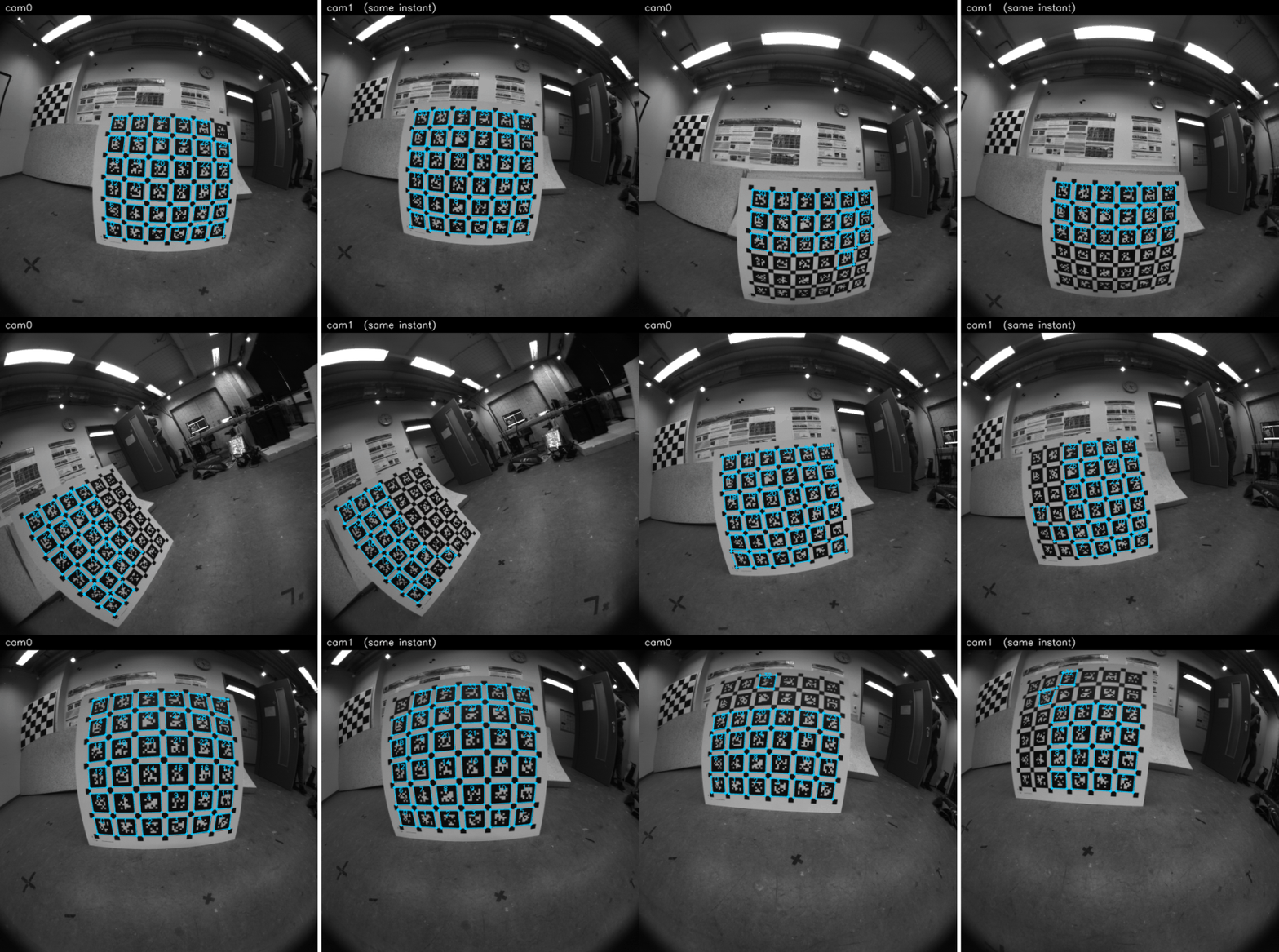
Calibrate each camera, compose the per-frame board poses, and you recover the stereo extrinsic
T_cam1_cam0 — matching TUM-VI's published transform to 0.062° rotation and 0.25 mm
baseline (~0.2%).
That's the next step up: see the stereo extrinsics chapter
and run python examples/06_stereo_extrinsics_tumvi.py --stride 8.
Back to the path: the theory chapters explain why each step here works —
Ch.3 (validity & the >180° cone) is ready; Ch.4 (Jacobians) and
Ch.5 (the LM math) are coming (see ../ROADMAP.md).